Table of Contents
- What Feel Free actually is
- What's in the bottle
- The $8.75 million settlement, explained
- The label warning that came out of it
- Where the FDA case landed
- What it costs
- What drinkers say it feels like
- The checklist: what to demand from any kava-kratom tonic
- The Feel Free timeline
- What kava brings, what kratom brings
- Honest alternatives
- FAQ
- Final thoughts
TL;DR
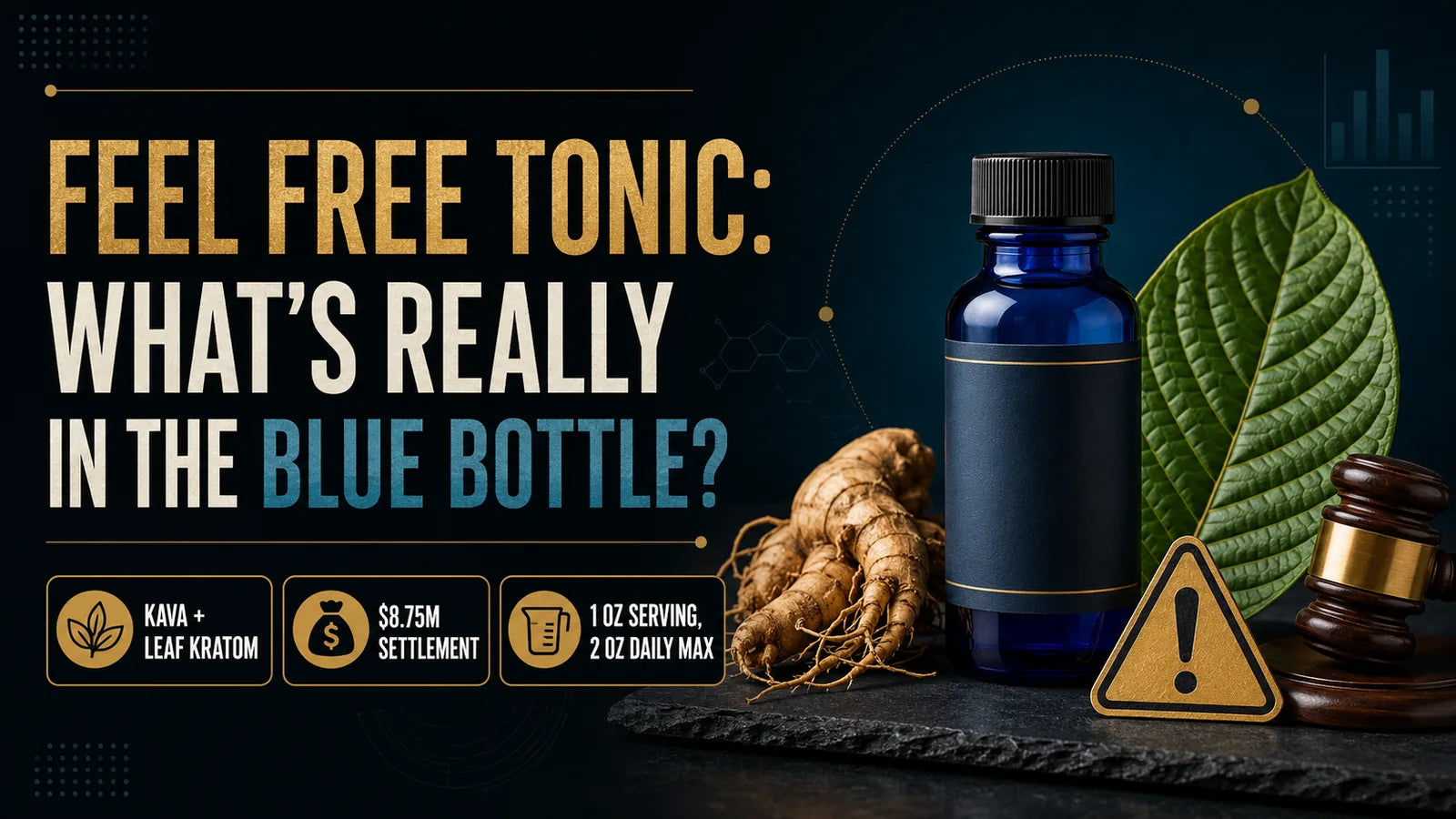
- Feel Free is a 2 oz kava and leaf-kratom tonic made by Botanic Tonics, sold everywhere from wellness shops to 7-Eleven coolers.
- Botanic Tonics settled an $8.75 million class action over marketing that didn't warn buyers about kratom's habit-forming potential. Final court approval came October 20, 2025.
- The settlement forced a plain-language warning onto every bottle and ad: leaf kratom can be habit-forming.
- The government's separate FDA seizure case was dismissed in December 2025, and the company is now suing Utah over new kratom rules in 2026. The legal story runs both directions.
- Our take: the product taught the whole category a lesson about transparency. Read labels, know your serving, and buy from brands that tell you exactly what's inside.
What Feel Free Actually Is
You've seen the little blue bottle. Gas station counter, yoga studio fridge, your friend's gym bag. Feel Free Classic is a 2 oz "wellness tonic" from Botanic Tonics that pairs kava extract with leaf kratom, pitched as a plant-based lift for focus and social ease.
It went viral before most buyers knew what kratom was. That gap (huge distribution, low ingredient awareness) is the entire reason this review needs a legal section, and the reason we're writing it. We make kava and kratom drinks ourselves at GudTonics, so we watched the Feel Free story unfold with more than casual interest. There's a lot to learn from it.
What's in the Bottle
The label on Feel Free Classic lists kava and leaf kratom as the active botanicals. The serving guidance is specific and worth respecting: 1 oz per serving, no more than 2 oz in 24 hours. One bottle is two servings, not one, which surprises approximately everyone who buys their first bottle.
Kava and kratom pull in different directions. Kava's kavalactones lean calm and social. Kratom's mitragynine, at drink-level servings, leans lifted and talkative. Blended, you get the "clear-headed social buzz" the brand built its following on. The blend also means you're consuming two active botanicals at once, which makes serving discipline matter twice as much.
The $8.75 Million Settlement, Explained
Here's the part the influencer posts skipped.
A class action alleged that Botanic Tonics marketed Feel Free as a safe, healthy alcohol alternative without warning consumers that kratom can be habit-forming. Plaintiffs said they had no idea the ingredient carried dependence potential until they were already reordering weekly.
The company agreed to pay $8.75 million, and the settlement received final court approval on October 20, 2025. Class members who bought Feel Free during the covered window were eligible for refunds.
Notice what the settlement was about. Not contamination. Not a dangerous ingredient by itself. Disclosure. The product didn't tell people what they were drinking, and that omission cost eight figures. Every brand in this category should have that number taped above their marketing desk.
The Label Warning That Came Out of It
As a condition of the settlement, Botanic Tonics added this disclosure to labels and social ads: "Warning: This product contains leaf kratom which can become habit-forming and cause serious adverse health effects."
Blunt words on a wellness product. Good. That's what informed choice looks like, and frankly the whole category is healthier for it. A warning label doesn't mean a product is evil; it means adults get to decide with the facts in front of them.
Where the FDA Case Landed
The legal story has a second act that cuts the other way, and fairness requires telling it.
The federal government had pursued a seizure case against a quarter million bottles of Botanic Tonics product. On December 22, 2025, the government filed a notice of dismissal, closing the matter. Botanic Tonics framed it as regulatory recognition that natural leaf kratom products differ from synthetic concentrates, and by spring 2026 the company went on offense, suing Utah officials over new kratom regulations it argues are unconstitutional.
So: paid a major settlement over past marketing, cleared of the federal seizure action, now litigating for the category's future. Complicated company. Simple lesson, though, and it hasn't changed: transparency first.
What It Costs
Court documents from the class action show plaintiffs paid $30 to $80 per pack depending on size and retailer. Single bottles typically run $8 to $12 at retail. Per proper 1 oz serving, that's roughly $4 to $6, which sits at the premium end of the kratom-drink market. You're paying for distribution and brand, partly. Small-batch tonic makers (hi) usually land cheaper per serving with more mitragynine transparency, but nobody matches Feel Free's ubiquity.
What Drinkers Say It Feels Like
Read a few hundred reviews and the pattern is consistent. At one ounce: smooth, social, mildly lifted, "like the good part of a drink without the fog." At two ounces: stronger, warmer, and for some people too much. The complaints cluster in two areas: people who treated a bottle as a single serving and felt queasy, and people who fell into daily multi-bottle habits and found stopping rough (the exact risk the settlement warning now names).
The taste? Earthy, bitter, rootsy. Nobody drinks it for flavor. Chase it cold and quick.
The Checklist: What to Demand From Any Kava-Kratom Tonic
Feel Free's saga wrote the buyer's checklist for this entire category. Use it on every brand, ours included.
- Named ingredients with amounts. "Proprietary blend" is a red flag. You deserve milligrams, not mystery.
- Clear serving guidance. Per-serving and per-day limits, printed where you can't miss them.
- Third-party lab results. Alkaloid content plus contaminant screens, batch by batch, one click away.
- A habit-forming disclosure. If a kratom brand won't say it, they're hiding the most important sentence.
- Natural leaf, not synthetic concentrate. Regulators are actively moving on boosted 7-OH products in 2026. Leaf-based drinks are a different, better-understood thing.

Five lines. If a brand clears all five, you can make a real decision. If it clears three, keep your money.
The Feel Free Timeline
Six years of story, one table. Useful the next time someone at a party has strong opinions and half the facts.
| When | What happened |
|---|---|
| 2020-2022 | Feel Free launches and spreads through influencer marketing and convenience-store distribution as a "sober alcohol alternative." |
| 2023 | Class action filed alleging the kratom content and its habit-forming potential weren't disclosed to buyers. Media coverage snowballs. |
| 2023-2024 | Federal seizure case targets 250,000 bottles. Health warnings and social media scrutiny peak. |
| October 20, 2025 | The $8.75 million class settlement receives final court approval. Warning labels become mandatory. |
| December 22, 2025 | Government dismisses the FDA seizure case against Botanic Tonics. |
| March 31, 2026 | Botanic Tonics and the Global Kratom Coalition sue Utah over new kratom regulations. |
Notice the arc: viral growth, disclosure reckoning, mandated transparency, then the company fighting for the category's regulatory future. Whatever you think of the brand, the timeline is the whole industry's cautionary tale compressed into one bottle.
What Kava Brings, What Kratom Brings
Understanding the blend helps you evaluate any product in this category, not only Feel Free.
Kava works through kavalactones, compounds studied for calm and sociability without cognitive fog. Pacific islanders have prepared it ceremonially for centuries. On its own, kava is the mellow end of the botanical drink world, and it carries no habit-forming reputation in the traditional literature.
Kratom works through mitragynine, which at drink-level servings leans lifted, social, and warm. It's the ingredient doing most of the heavy lifting in the "feels like the good part of a drink" reports, and it's also the ingredient responsible for every warning label in this article. Habit formation with daily use is documented and real.
Blended, the two round off each other's edges: kava softens kratom's push, kratom brightens kava's calm. A good blend is a genuinely pleasant thing. It's also two actives in one serving, which is exactly why published amounts and serving caps aren't optional paperwork. They're the product.
Honest Alternatives
Where else to look if the blue bottle isn't your fit:
- GudTonics kava + kratom tonics. Our lane. Measured servings, labeled alkaloid content, lab results on every batch, and flavors we're genuinely proud of. Start with the Tropicolada if you want the tropical route.
- Mitra-9 seltzers. Canned, carbonated, 45 mg mitragynine per can, no kava. Lighter format, we reviewed them separately.
- Straight kava drinks. No kratom at all, fully calm lane. Good for evenings or anyone avoiding mitragynine entirely.
FAQ
Is Feel Free safe to drink?
It's a legal botanical product with a court-mandated warning: leaf kratom can be habit-forming. Respect the 1 oz serving and 2 oz daily cap, don't mix it with alcohol or medications, and skip it entirely if you're pregnant or have liver concerns. When in doubt, talk to your doctor.
Why did Feel Free get sued?
The class action alleged the product was marketed as a safe alcohol alternative without disclosing kratom's dependence potential. It settled for $8.75 million with final approval in October 2025, and labels now carry a warning.
Was Feel Free banned?
No. The federal seizure case was dismissed in December 2025, and the product remains on shelves in most states. Some states and cities restrict kratom products generally, so local rules vary.
How much kratom is in Feel Free?
The label lists leaf kratom but the company doesn't publish a per-bottle mitragynine number, which is exactly the transparency gap our checklist flags. Brands that publish alkaloid content make comparison possible.
What's the difference between Feel Free and GudTonics?
Both blend kava and kratom. We publish what's in ours, batch by batch, with serving guidance built for actual humans. We'd rather earn trust with paperwork than distribution deals.
Final Thoughts
- Feel Free built the kava-kratom tonic category and then paid $8.75 million for under-explaining it.
- The mandated warning made the whole shelf more honest. That's a win for everyone.
- The FDA case dismissal and the Utah lawsuit show the legal ground is still moving under this category in 2026.
- Buy from whoever passes the five-point checklist. Full stop.
We started GudTonics because we thought botanical drinks deserved craft-beverage standards: real recipes, real testing, real labels. If you're curious what a transparent kava-kratom tonic tastes like, try the lineup and check the lab results before you sip. That's how it should work.
This review is based on public court records, press releases, and product information as of July 2026. It's education, not medical advice. These statements have not been evaluated by the FDA.