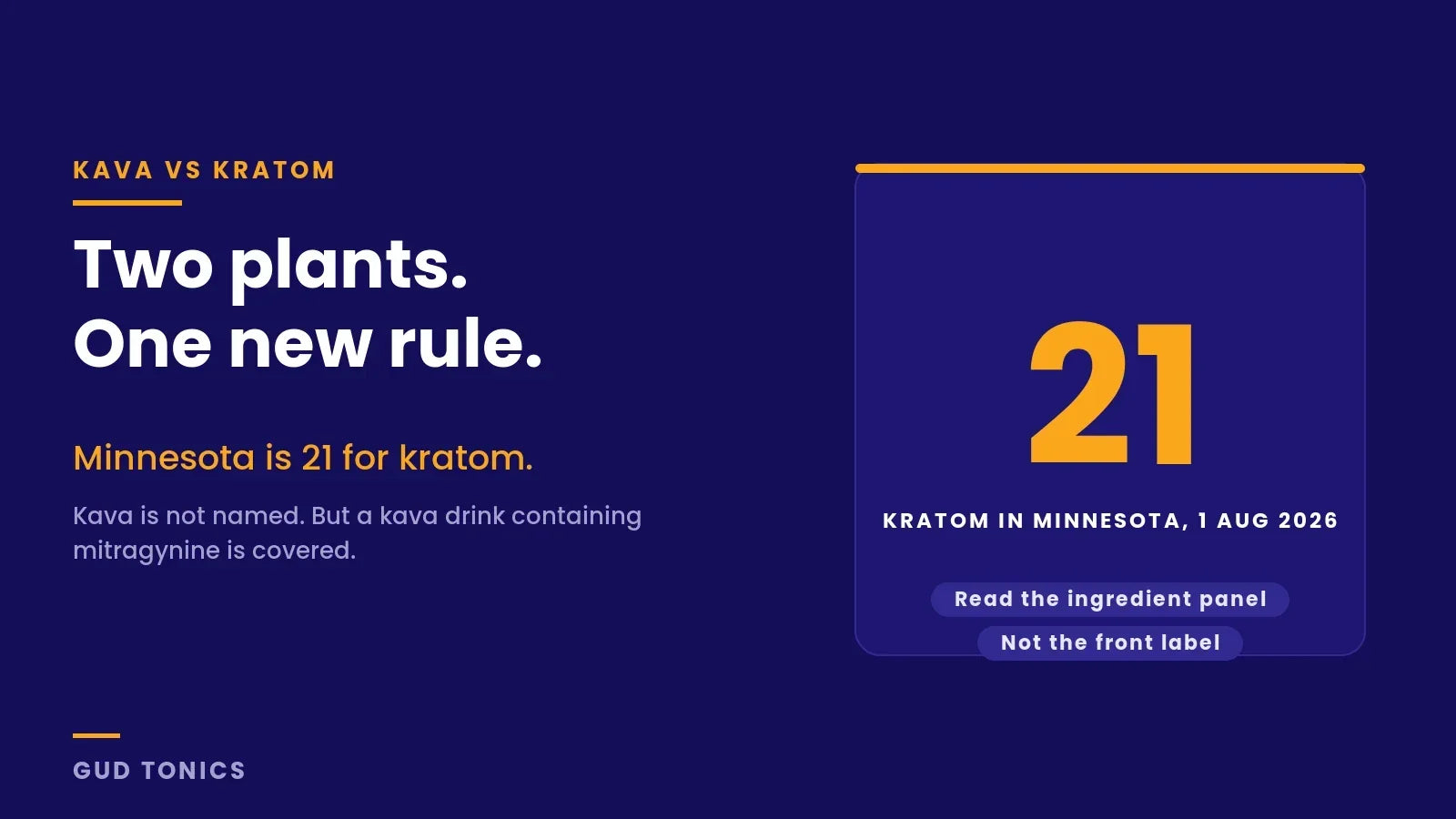
Kava vs kratom is the question we field more than any other, and as of 1 August 2026 it carries a legal edge in Minnesota. So here is the plain version, before anything else. Kava and kratom are two completely unrelated plants that get lumped together because they turn up in the same bars, the same coolers and often the same conversation. Minnesota raised the age to buy or possess kratom from 18 to 21, and that change is already in force. The law never says the word kava.
Which sounds like a clean answer for anybody holding a kava drink. It is not, quite. The statute does not stop at the word kratom, and that is the whole reason this article exists.
Kava vs kratom: two plants with nothing in common
Start with the botany, because almost every mix-up traces back to it.
Kava is Piper methysticum, a shrub in the pepper family, native to the South Pacific. People use the root. Islanders have been preparing it as a beverage for ceremony and community for thousands of years, and the National Center for Complementary and Integrative Health notes that kava drinks are now sold at kava bars across the United States. Its active compounds are called kavalactones, and the six that matter most are kavain, dihydrokavain, methysticin, dihydromethysticin, yangonin and desmethoxyyangonin.
Kratom is Mitragyna speciosa, a tree in the coffee family, native to Southeast Asia. People use the leaf. Its two headline compounds are mitragynine and 7-hydroxymitragynine, usually shortened to 7-OH. Mitragynine makes up roughly two thirds of the plant's alkaloid content. The 7-OH is a breakdown product of mitragynine, and the leaf itself produces very little of it naturally, usually under 0.05 percent by weight, though the body converts some mitragynine into 7-OH in the liver. Both compounds act on opioid receptors, which is precisely the reason legislatures write rules about them and nobody writes rules about kavain.
The practical consequence of that gap is that anyone drafting a kratom rule has to choose whether to regulate a plant, a product category or a set of molecules, and the drafters in St. Paul went with the molecules, which is exactly why a Minnesota shopper holding a cold bottle of something cannot settle the legal question by knowing which plant is pictured on the front of it.
Different family. Different continent. Different part of the plant. Different chemistry entirely. If you take one thing from this section, take that.

Kava vs kratom, side by side
Here is the comparison in one place, with the Minnesota column filled in for the rule that took effect on 1 August 2026.
| Kava | Kratom | |
|---|---|---|
| Plant | Piper methysticum, a shrub in the pepper family from the South Pacific | Mitragyna speciosa, a tree in the coffee family from Southeast Asia |
| Part used | The root | The leaf |
| Active compounds | Kavalactones: kavain, dihydrokavain, methysticin, dihydromethysticin, yangonin, desmethoxyyangonin | Mitragynine and 7-hydroxymitragynine, plus minor alkaloids such as paynantheine and speciogynine |
| How they act | A separate chemical class from kratom alkaloids, and one no Minnesota controlled substance statute names | Both mitragynine and 7-OH act on opioid receptors, per the Minnesota Department of Health |
| Named in Minn. Stat. Sec. 152.027 | No, not anywhere in the section | Yes, by plant name and by compound name |
| Minnesota status after 1 August 2026 | Legal. Not banned, not scheduled, no state age rule written into the kratom statute | Legal for adults 21 and over. Not banned and not scheduled, but age restricted |
| What to check on a label | Kava, kava root, kavalactones, Piper methysticum, and nothing from the kratom column | Kratom, mitragynine, MIT, Mitragyna speciosa, 7-OH, 7-hydroxymitragynine |
Notice the row that does the work. It is not the botany row. It is the label row.
What Minnesota's law actually says
The change came through House File 3453, carried by Rep. Jessica Hanson of Burnsville, with Senate File 3704 as its companion. Governor Tim Walz signed it on 5 May 2026, and it took effect on 1 August 2026, applying to conduct on or after that date. It sits in Minnesota Statutes section 152.027, the chapter headed Other Controlled Substance Offenses, at subdivision 7.
The operative wording is short enough to read in full. Selling any amount of "kratom or a substance that contains mitragynine or 7-hydroxymitragynine" to a person under 21 is a gross misdemeanor, and possession of the same by a person under 21 is a misdemeanor. The only thing the 2026 amendment changed was the number: it struck 18 and wrote 21. Every other word, including the compound names, was already on the books.
That phrasing is the entire story. A drafter who only wrote "kratom" would have created an obvious loophole for anything not sold under that name, so they named the molecules as well. MPR News reported on 3 August 2026 that the change landed alongside a rise in kratom-related poison center calls in the state and growing concern about how potent some products on gas station and smoke shop shelves have become.
It is worth being equally clear about what the law does not do. It does not ban kratom in Minnesota. It is not a scheduling action, so kratom is not a controlled substance there. The Minnesota Department of Health does not regulate the sale or possession of kratom, and this change attached no licensing, testing or labeling regime to it. Adults 21 and over can still buy. That is the shape of the rule: an age gate, not a prohibition.
Is kava legal in Minnesota?
Yes. Kava is legal in Minnesota and legal in all fifty states. It is not a federally scheduled controlled substance, it is not scheduled in Minnesota, and the word kava appears nowhere in section 152.027. If you are drinking a kava beverage whose only actives are kavalactones, the 21 rule does not reach it.
Two honest footnotes belong with that yes, because "legal" is not the same as "no rules and no risks."
The first is federal. Kava is sold in the United States as a dietary supplement, and dietary supplements are not approved by the FDA before they go on sale. The second is safety, and it is the more important of the two. Kava has been linked to rare cases of liver injury, some of them serious and some fatal, and the NCCIH is direct about that. It can also cause digestive upset, headache and dizziness, and long-term high-dose use can cause a dry, scaly skin condition called kava dermopathy. Kava should not be combined with alcohol or with other sedatives such as benzodiazepines, and it carries specific risks in pregnancy and breastfeeding. If you take any prescription medication, ask your clinician before you start.
So kava is legal, and kava still deserves a label read and a conversation with your doctor. Both things are true.

Read the ingredient panel, not the front of the bottle
Here is where the kava vs kratom question stops being botany and starts being shopping.
Nothing stops a drink from being sold as kava while also containing mitragynine. That is not a trick or a scandal, it is just a formulation choice, and plenty of brands make it, including us. But Minnesota named the compound, not the marketing category, so a bottle with a hibiscus on the front and MIT in the panel is covered by the 21 rule exactly as much as a bag of leaf powder is.
Which is the whole reason we are writing a comparison piece instead of a legality piece. Two plants, one law, and a decision that turns on a line of small print.
Three checks, in order:
- Does the panel list mitragynine, MIT, kratom, Mitragyna speciosa, 7-OH or 7-hydroxymitragynine? If yes, it is covered in Minnesota. Adults 21 and over only.
- Does it list only kava, kava root, Piper methysticum or kavalactones? Then the kratom statute does not reach it.
- Is the panel vague, or is there no certificate of analysis anywhere? Treat that as its own answer. A product that will not tell you what is in it cannot tell you whether it is legal where you live, and it certainly cannot tell you how much you just drank.
That third one matters more than people expect. Poison Control makes the point plainly: kratom products are not standardized, so a consumer often has no reliable way to know the dose they received or whether anything else is in there. Independent lab numbers are the fix, and they are cheap to publish, which is why the absence of them tells you something.
Which GUD Tonics drinks the Minnesota rule reaches
We are going to answer this about our own shelf, with numbers, because a comparison article that dodges its own products is not worth reading.
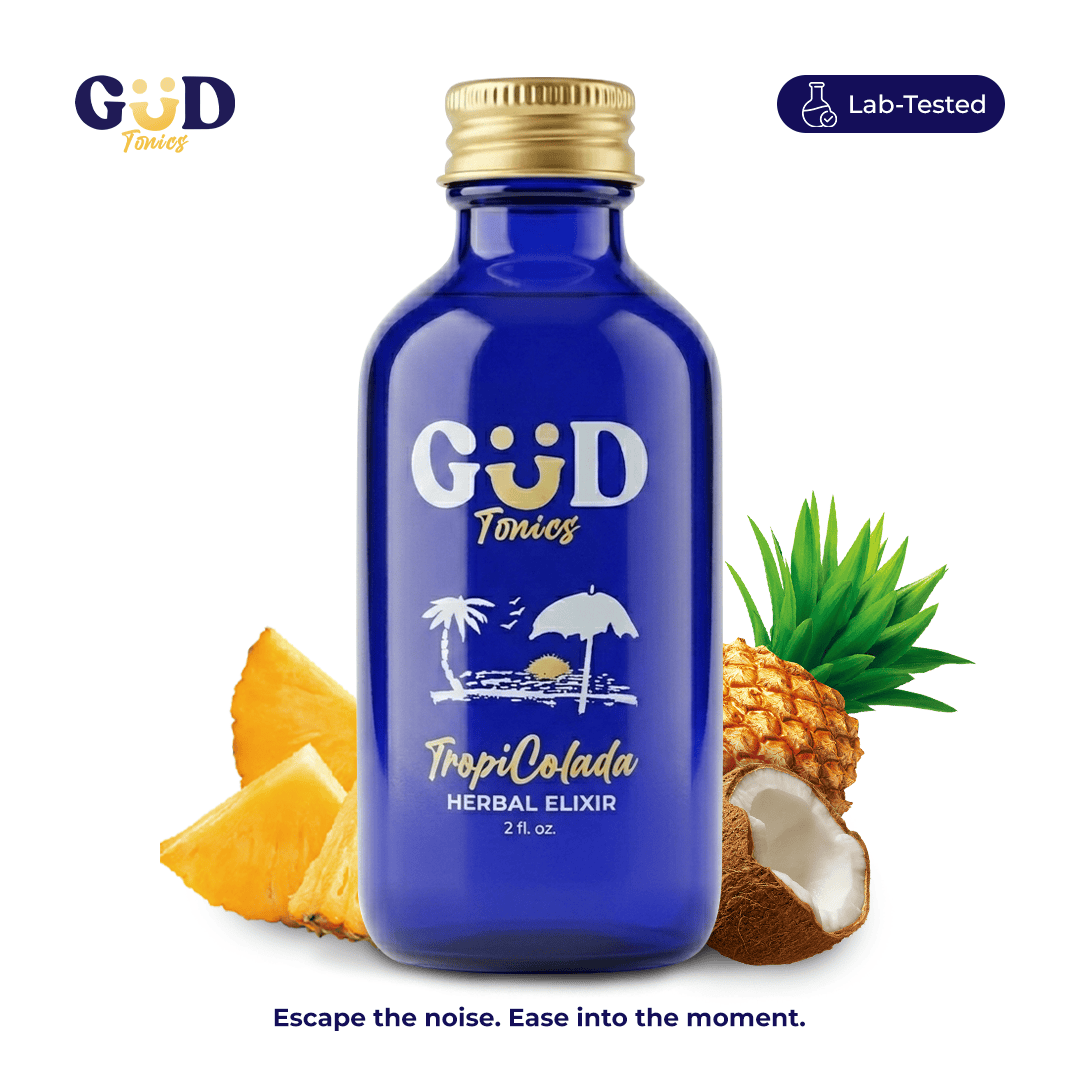
Three of our ready-to-drink tonics blend noble kava root extract with Mitragyna speciosa. All three contain mitragynine, and all three are therefore covered by Minnesota's 21 rule. Our published certificates of analysis, run by Cora Science in Austin on 60 mL bottles, show it in milligrams:
- TropiColada (SKU 55470), lot 06/19/25: 79.7 mg mitragynine per bottle, 7-OH below the limit of quantitation, 110 mg total Mitragyna alkaloids, 535 mg total kavalactones.
- Baja Bliss (SKU 76845), lot 06/19/2025: 80.9 mg mitragynine per bottle, 7-OH below the limit of quantitation, 102 mg total Mitragyna alkaloids, 451 mg total kavalactones.
- Pink Sunset (SKU 76845-1), lot 06/17/2025: 79.4 mg mitragynine per bottle, 7-OH below the limit of quantitation, 104 mg total Mitragyna alkaloids, 536 mg total kavalactones.
- The GUD Tonics Bundle contains one of each of the three, so it is covered too.
Each bottle is labeled as two servings, so roughly 40 mg of mitragynine per serving. For scale, when Rhode Island repealed its own kratom ban in April 2026 and reopened under a licensed framework, it capped servings at 150 mg of mitragynine and 1 mg of 7-OH. Our per-serving number sits well under that ceiling, and we mention it because a number is more useful to you than an adjective.
We blend the two because the combination is what our customers came for, not because we are trying to slide anything past a label reader, and the trade-off we accept for that choice is exactly the one this article describes: every rule anywhere in the country that names mitragynine reaches those three flavors, and we would rather say so on our own blog than let somebody find out at a checkout screen or, worse, from a police officer.
Our fourth product is the odd one out. The Raw Kava Extract Powder carries a certificate identifying it as Piper methysticum, root, from Vanuatu, standardized to 30.28 percent kavalactones, with heavy metals and pesticide residue within spec. There is no Mitragyna alkaloid panel on it, because there is no Mitragyna in it. It is the kava-only item in the range.
That certificate is the point, and it is worth saying why. A badge on the front of a package, a category tile on a website, a product type field in a store's back end: those are all merchandising labels. People write them, sometimes in a hurry, sometimes before a formula is finished, and not one of them is an analytical result. The ingredient panel tells you what went into the bottle. The certificate tells you what a laboratory found in it. Where a marketing layer and those two documents disagree, believe the documents, and treat the disagreement itself as information about how carefully that brand keeps its own paperwork. Every one of our lab reports lives on the lab results page with the lot number and the date on it, so check us against our own paperwork rather than our own adjectives. Hold every brand you buy to that same test, ours included.
Our own position on the age question is simple and does not depend on which flavor you pick. We sell to adults 21 and over. Age-gating is what this industry asked for and it is what we practice, so nobody needs to work out which SKU falls on which side of a Minnesota line before they can order responsibly.
Safety, and the numbers worth saving
A legal comparison is not a safety comparison, so let us separate them.
On the kratom side, reported effects run from nausea, constipation, headache, dizziness, drowsiness and tremor through raised heart rate, raised blood pressure and anxiety, and in more serious cases seizures, psychosis, liver toxicity and dependence. Low doses of mitragynine tend toward stimulant-like effects while higher doses tend toward sedation. The 7-OH picture is different again: research suggests it may be roughly thirteen times more potent than morphine, and concentrated or added-7-OH products, the shots and tablets and gummies you see marketed as natural and mild, can be far stronger than leaf. In July 2025 the FDA sent warning letters to companies putting concentrated 7-OH into foods and beverages, saying those ingredients cannot legally be added to conventional foods. Kratom, 7-OH included, is not FDA approved for anything.
For a sense of scale, federal survey data put past-year kratom use in the United States at roughly 1.7 million people aged 12 and over in 2021, which is a large enough population that even uncommon harms turn up reliably in poison center data, and Minnesota's kratom-related call volume has been climbing for a while now. That is the backdrop the legislature was working against. Not a moral panic, a call log.
If something goes wrong, do not spend twenty minutes searching. Call the Minnesota Regional Poison Center at 1-800-222-1222, which is free, confidential and staffed 24 hours a day, or use the Poison Control kratom guidance if you want to read first. If someone is unresponsive, having a seizure, or not breathing normally, call 911 for immediate medical attention. Naloxone reverses opioid overdose, including cases involving 7-OH, and bystander naloxone saves lives.
One line we want on the record, because we have watched other brands blur it. Kava is not a treatment for kratom dependence, not a way to taper, and not a substitute for stopping. It is a drink. If kratom use has become something you want out from under, the medicines with actual evidence behind them are buprenorphine, methadone and naltrexone, and that conversation belongs with a clinician, not with a beverage company.
Minnesota regulated. North Dakota banned for thirty days. Same month.
Two neighboring states moved in opposite directions inside two weeks, and watching them side by side tells you more about where this category is heading than any single headline does.
Minnesota kept kratom legal and moved the age to 21 on 1 August 2026. Four days later, North Dakota went the other way entirely: Executive Order 2026-04 took effect at 5 p.m. on 5 August 2026 and prohibits the sale, purchase and possession of kratom products outright. Same compounds, same month, two completely different answers. We wrote up what that order means for kava drinks in our North Dakota post, and the underlying logic is identical to this one: the order names mitragynine, so it reaches blended kava tonics even though it never says kava.
Two details keep that comparison honest, and most coverage left both of them out. The order is temporary. It runs thirty days and lapses around 4 September 2026 unless something replaces it, and Governor Armstrong has called a special legislative session for 2 September 2026 to decide whether prohibition goes into North Dakota statute. So North Dakota does get a vote. It is simply taking that vote after the ban is already in force rather than before it. The second detail outlasts the first: the North Dakota Board of Pharmacy issued a separate emergency rule scheduling 7-OH as a controlled substance for about 180 days, which is still running long after the order lapses. If you buy or drink anything with a 7-OH line on its certificate, that rule is the one to watch.
If you take the pattern seriously, the practical lesson is that the plant name on the front of a bottle is becoming the least reliable guide to whether you can legally buy it. The compound list is what regulators write about, and the compound list is on the back.
What to do if you are in Minnesota
Three things, and none of them take long.
If you are under 21 in Minnesota, you cannot buy or possess kratom or anything containing mitragynine, and that has been true since 1 August 2026. Nothing about this article is an argument for finding a way around that, and if you were hoping for one, the answer is no.
If you are 21 or over, get in the habit of turning the bottle around. Look for mitragynine, MIT, kratom or 7-OH in the panel, and look for a certificate of analysis with a lot number and a date on it. Every brand worth buying will hand you both without being asked, and the ones that hesitate have told you something.
And if you are the person at the bar who has been told all evening that kava and kratom are basically the same thing, now you know they are not, and you also know why that distinction alone will not answer the legal question. What is in the bottle answers it. Read the panel. Then pour something you actually want to drink.
This article is general information, not legal or medical advice. Kratom and kava rules differ by state, county and city, they change often, and you should verify the current position with an attorney or your state authority before acting. GUD Tonics products are for adults 21 and over only, are not for anyone who is pregnant or breastfeeding, and should never be combined with alcohol. These statements have not been evaluated by the Food and Drug Administration. This product is not intended to diagnose, treat, cure or prevent any disease.