Listen to this page
Read by an AI voice. The full article is read aloud, top to bottom, including both boxes.
Help first, because some of the products this notice is about are ones people have trouble stopping. If someone is difficult to wake, is not breathing normally, or is unresponsive, call 911.
Anywhere in the United States: Poison Control on 1-800-222-1222 for a question about a product in your hand. The 988 crisis lifeline, by call or text. The federal treatment locator is findtreatment.gov. New Jersey's announcement carries no helpline of its own.
Every clinical question this notice raises belongs with a clinician who can actually see you. Not with us. We make drinks for a living, which is a completely different job.

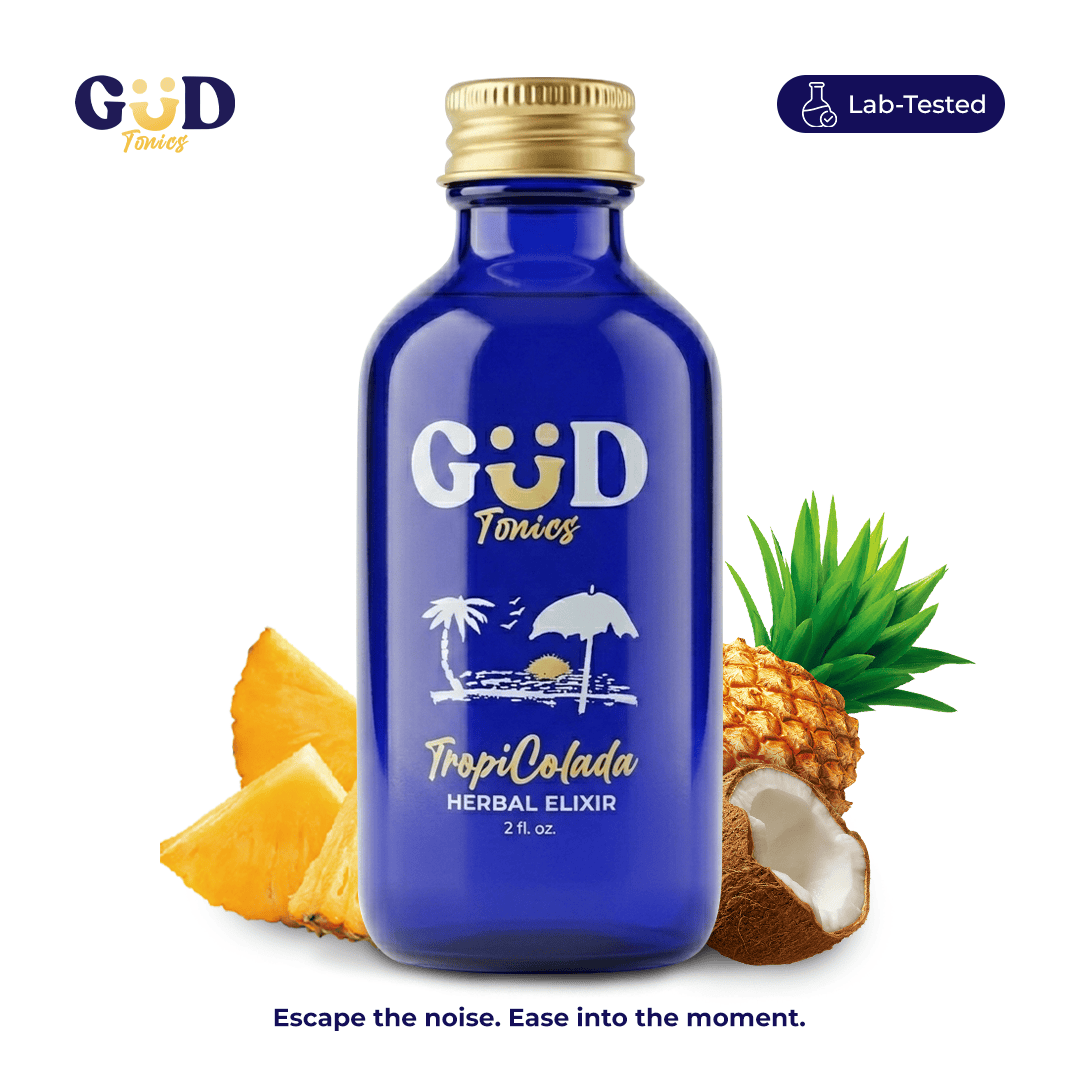
If you drink our tonics in New Jersey, here is the whole notice in three sentences. On 25 September 2026 three synthetic kratom-related compounds became Schedule I controlled dangerous substances in New Jersey. None of them is an ingredient in any GUD Tonics product: they are made in a laboratory, and we do not add them. All three of our drinks, Baja Bliss, Pink Sunset and TropiColada, do contain kratom leaf extract, which New Jersey did not schedule and which each of them lists on its ingredient panel as Mitragyna speciosa.
The rest of this page is what we can and cannot say about our own bottles, what the state actually said, why products sold as "kava" are part of this story at all, and the one honest limit on what our own certificates can prove as of the date below. We wrote a notice like this for Massachusetts in August. Less changed this time, and the part that did change is on the shelf rather than in our bottles.
Checked 28 September 2026. In New Jersey, mitragynine pseudoindoxyl, MGM-15 and MGM-16 have been Schedule I since 25 September 2026, by operation of the state's 30 day rule after the federal order of 26 August. Natural kratom is not scheduled in New Jersey or federally, and kava is named in neither the state's release nor the federal order. Two New Jersey bills, S301 and S1384 with companion A4222, are in committee and are not law.
Our products. Our three drinks list Mitragyna speciosa, the kratom plant, on the ingredient panel, and our three-drink bundle holds the same three. Our Raw Kava Extract Powder is kava root only. We do not add any synthetic kratom-related compound to anything. Our current certificates do not test for the three scheduled compounds, and the section on our certificates says so plainly.
Next review 28 October 2026, or the day any of the above changes.
What New Jersey said, in its own words
The Attorney General's public alert of 25 September 2026 says the state is "alerting the public that starting today certain synthetic compounds related to the substance "kratom" will be illegal to possess and sell in New Jersey under a temporary order issued by the federal government." It names them: "mitragynine pseudoindoxyl, MGM-15, and MGM-16". And it draws the line that matters for a drink company:
Natural kratom and other synthetic kratom-related compounds not scheduled will not be illegal in New Jersey as a result of this change in federal law. However, no forms of kratom or related synthetic compounds have been shown to be safe or effective to treat any medical condition.
The date is the 25th, not the 26th. The release is dated 25 September and says "starting today"; WFMZ's report ran under the headline "Certain synthetic kratom compounds become illegal in NJ under federal order". The mechanism is automatic: "Under New Jersey law, if the federal government schedules a drug and the Director of the Division of Consumer Affairs does not object, which he did not in this case, that drug automatically becomes scheduled in New Jersey too." The federal temporary order published on 26 August and is "effective August 26, 2026, until August 26, 2028"; thirty days after publication is 25 September. New Jersey's release says the DEA's temporary scheduling order "will remain in effect until at least August 26, 2028, unless the Division changes it."
What is in our bottles, and what is not
The three scheduled compounds are not plant alkaloids. The federal order says that, unlike the alkaloids that occur naturally in the plant, they "are produced through synthetic modifications of purified mitragynine isolates" or of another purified kratom alkaloid. We do not add them to anything we make. The Department of Justice adds a complication in its own words: "scientific and analytical questions remain about whether MGPI may be reported at incidental trace levels in some botanical products as a result of processing, storage or analytical conditions." That sentence is why the section on our certificates below matters.
What our three drinks do contain is kratom leaf extract, and each of them says Mitragyna speciosa on its ingredient panel. That is the sentence we have been writing since our Massachusetts notice in August and since our piece on why kava is not a treatment for kratom withdrawal, and it does not change because New Jersey acted. Kratom leaf is legal in New Jersey. It is also, in the words of the state's own release, a substance whose use "can lead to psychotic symptoms and psychological and physiological dependence", which is why the help box is at the top of this page and not the bottom. Our fifth product, Raw Kava Extract Powder, is kava root extract with no kratom in it, per its manufacturer's certificate; we are not linking it here, because a page like this should not end in a product recommendation.

Why products sold as "kava" are part of this story
This is the reason a kava company is writing about a kratom scheduling at all. In October 2025 the Alabama Poison Information Center and local addiction clinicians identified, in the words of a paper published in Clinical Toxicology in August 2026, "a cluster of cases involving liquid products marketed as containing kava associated with opioid-like withdrawal symptoms." Five products were tested. "Qualitative GC-MS detected both mitragynine and kavalactones in one product, while another contained mitragynine with no detectable kavalactones. Quantitative UPLC-MS/MS identified both kavalactones and kratom alkaloids in three products, with mitragynine pseudoindoxyl predominating at concentrations of 0.16-0.21 mg per bottle." The paper's title is "Unlabeled kratom alkaloids detected in products marketed as kava."
Read that against the New Jersey release. A liquid sold as kava, with mitragynine pseudoindoxyl in it and nothing on the label, contains a compound that has been Schedule I in New Jersey since 25 September. The amounts in the Alabama products were small, a fraction of a milligram per bottle, and the federal order sets no threshold: "Possession of any quantity of mitragynine pseudoindoxyl, MGM-15, or MGM-16 in a manner not authorized by the CSA on or after August 26, 2026 is unlawful". The Department of Justice has said federal prosecutors "will exercise enforcement discretion when only incidental trace amounts of MGPI are confirmed in a product otherwise consistent with botanical kratom", and that this does not apply to MGM-15 or MGM-16, "or products containing manufactured, concentrated, fortified or intentionally added MGPI." New Jersey's release says nothing of the kind. What a court would make of a kava bottle with 0.2 mg of a scheduled compound in it is a question for a lawyer. What a customer should make of it is simpler: a bottle that does not say what is in it cannot tell you whether it contains a Schedule I drug, and after Alabama that is not a theoretical worry.
The wider pattern is on the federal record too. The CDC reported in April 2026 that poison center calls involving kava had risen to "203 reported exposures in 2025", that "reports involving combined use of kava and kratom have increased, reaching 30% (61) of all kava reports in 2025", and that "kava and kava-kratom combination products sold in the United States are unregulated". Nebraska Medicine put the consumer version plainly in September 2025: "Some products combine both substances in one bottle. Because these products aren't well regulated, strength and ingredients vary a lot." We are one of the companies that combines them. The difference we can offer is that ours say so.
What our certificates prove, and the one thing they do not yet
Our drinks are tested by an independent laboratory, Cora Science, and their certificates are on our lab results page; our kava powder's certificate is its manufacturer's. They report what the laboratory quantified. Here is the honest limit: mitragynine pseudoindoxyl is not a line on those certificates, because until August 2026 it was not a controlled substance and, as the federal order itself notes, "closely related compounds require specific method and instrumentation for accurate identification" and the order says gaps in forensic data "may be due to lack of readily available analytical reference standards". A certificate that does not name a compound has not tested for it. So the truthful statement about our bottles as of the date in the box above is not "pseudoindoxyl not detected". It is "pseudoindoxyl not looked for, and not added".
The second half of that sentence is the one we can stand behind as of the date in the box above, because we do not buy or add the compound. The first half is the one that can be fixed, and the fix exists: the laboratory that tests our drinks now runs a panel of mitragynine derivatives that names all three scheduled compounds, and its newer certificates for other products carry it. Our current drink certificates, issued on 6 August 2026, predate it. Until a drink certificate carries that panel, we would rather you knew the gap than assumed a certificate covers something it never claimed to.
How to read any bottle in New Jersey now
Turn it around. If the ingredient panel or the product name carries the words pseudoindoxyl, pseudo, MGM-15 or MGM-16, it is being sold as a compound New Jersey scheduled on 25 September, whatever the front of the bottle calls itself. If the panel lists kava, kava root or kavalactones only, it is a kava product. If it lists mitragynine, MIT, Mitragyna speciosa or kratom alongside the kava, it is a kava and kratom product, like our three drinks, and it is legal in New Jersey with the dependence question that comes with mitragynine. If the panel is vague, or the bottle has no panel, that is the answer: after Alabama, a liquid that will not say what it contains is the one to put back. And remember what Alabama actually showed: a panel is the seller's claim. The proof is a certificate for that lot whose panel names the three compounds.

There is one more thing worth knowing about New Jersey specifically. The state has no age limit, labeling rule or testing rule for kratom products in statute. A bill that would create one, S1384, would ban sales to anyone under 21, require the sign "SALE OF KRATOM TO PERSONS UNDER 21 YEARS OF AGE IS PROHIBITED BY LAW.", ban "any kratom product containing any synthetic alkaloids", and require labels to state the alkaloid content. It was referred to the Senate Commerce Committee on 13 January 2026 and no further action is recorded. Until it moves, the label standard in New Jersey is whatever each company chooses, and ours names Mitragyna speciosa on every drink that contains it.
What stays the same in New Jersey
Kava was never part of this. Kava is named in neither New Jersey's release nor the federal order, and the three scheduled compounds have nothing to do with the kava plant, except that mitragynine pseudoindoxyl turned up in liquid products marketed as kava in the Alabama cluster. Our kava powder is exactly as legal in New Jersey on 28 September as it was on 24 September, and so are our three drinks that combine kava with kratom leaf extract. What the state asked of consumers was caution with "all kratom and related products", and the honest reading of that is: know what is in the bottle, which is a labeling question we can answer, and know what mitragynine does with regular daily use, which is a dependence question we have written about at length and will not soften here.
For any New Jersey shop that stocks our drinks, the practical change is a shelf check rather than a product change. Anything on the shelf that contains mitragynine pseudoindoxyl, MGM-15 or MGM-16, from any brand, has been a Schedule I controlled dangerous substance since 25 September; those words on a label are the plainest warning, and the Attorney General's release says "Any individual or business found violating this ban could face criminal charges." We do not add them to ours. Our certificates, lot by lot, are the document to keep beside the register for the day a customer or an inspector asks; the panel gap described above is on those certificates too, and a shop that is asked about it can point at this page rather than guess.
What we will not do
We will not run a New Jersey promotion off this. Nothing on this page is a reason to buy more of anything than you would have bought before 25 September, and a company that used a scheduling announcement to move stock would deserve the reputation it got. We will not describe any drink as safe; New Jersey's Acting Director asked consumers to "utilize utmost caution with all kratom and related products", and a company that sells three kava and kratom drinks does not get to argue. And we will not tell a person who has been drinking an unlabeled product and now feels unwell on the days they skip it that our bottle is the answer. It is not. A clinician is, and the numbers at the top of this page reach one.
If you are a New Jersey customer with a question about a specific bottle of ours, write to us with the lot number and we will send you its certificate. If you find a sentence on this page that its source no longer supports, the same address gets it corrected with the date on it.
Three questions New Jersey customers may have
Can I still buy GUD Tonics in New Jersey?
Yes. The three scheduled compounds are made in a laboratory and we do not add them to anything. Our three drinks contain kratom leaf extract, which is legal in New Jersey and listed on the panel as Mitragyna speciosa; our kava powder contains kava root only.
Do your drinks contain pseudoindoxyl?
We do not add it, and it is not an ingredient in anything we make. Our current certificates do not test for it, which is the gap described above, and until a certificate does, that is as far as we can honestly go.
I have been drinking a kava shot from somewhere else and I feel awful when I stop. What now?
Take the bottle to a clinician, or call Poison Control on 1-800-222-1222 with it in your hand, and say exactly that. The Alabama cluster was people in your position, and the products turned out to contain kratom alkaloids the label never mentioned. Do not switch to one of ours to manage it; that is a substitution we will not sell.
Disclaimer: this notice summarizes publicly available material as of 28 September 2026 and links to primary sources so you can check them. It is general information about our products and New Jersey law as we understand it, not legal or medical advice, and no substitute for counsel in New Jersey or for a clinician. Statements about botanical products have not been evaluated by the Food and Drug Administration, and no product is intended to diagnose, treat, cure or prevent any disease.