One state in America has repealed an active kratom ban and put a regulated market in its place. Exactly one. Rhode Island. And the very first prohibited category in the law it wrote instead of the ban is a kratom product that is a conventional food or beverage, or that is labeled as one. A ready to drink kratom tonic is a beverage. Under that law the format is prohibited before a bottle is opened, before a laboratory measures a single alkaloid, and before any of the thresholds this industry has spent the year arguing about become relevant at all. That is not a hedge and it is not a technicality.
The sentence that does it
Here is the language, in full, from R.I. Gen. Laws section 21-28.12-3. A person shall not prepare, distribute, sell, possess, or advertise "a kratom product that is a conventional food or beverage or labeled as a conventional food or beverage product." It is item one on a list of twelve prohibited categories, and it sits above every milligram limit, every heavy metal ceiling and every packaging requirement that follows it on the page.
Read what it does not say. It does not say a kratom beverage above a certain strength. It does not say a kratom beverage sold without a certificate, or without a license, or to anyone under twenty-one. It describes a shape, and it prohibits the shape.
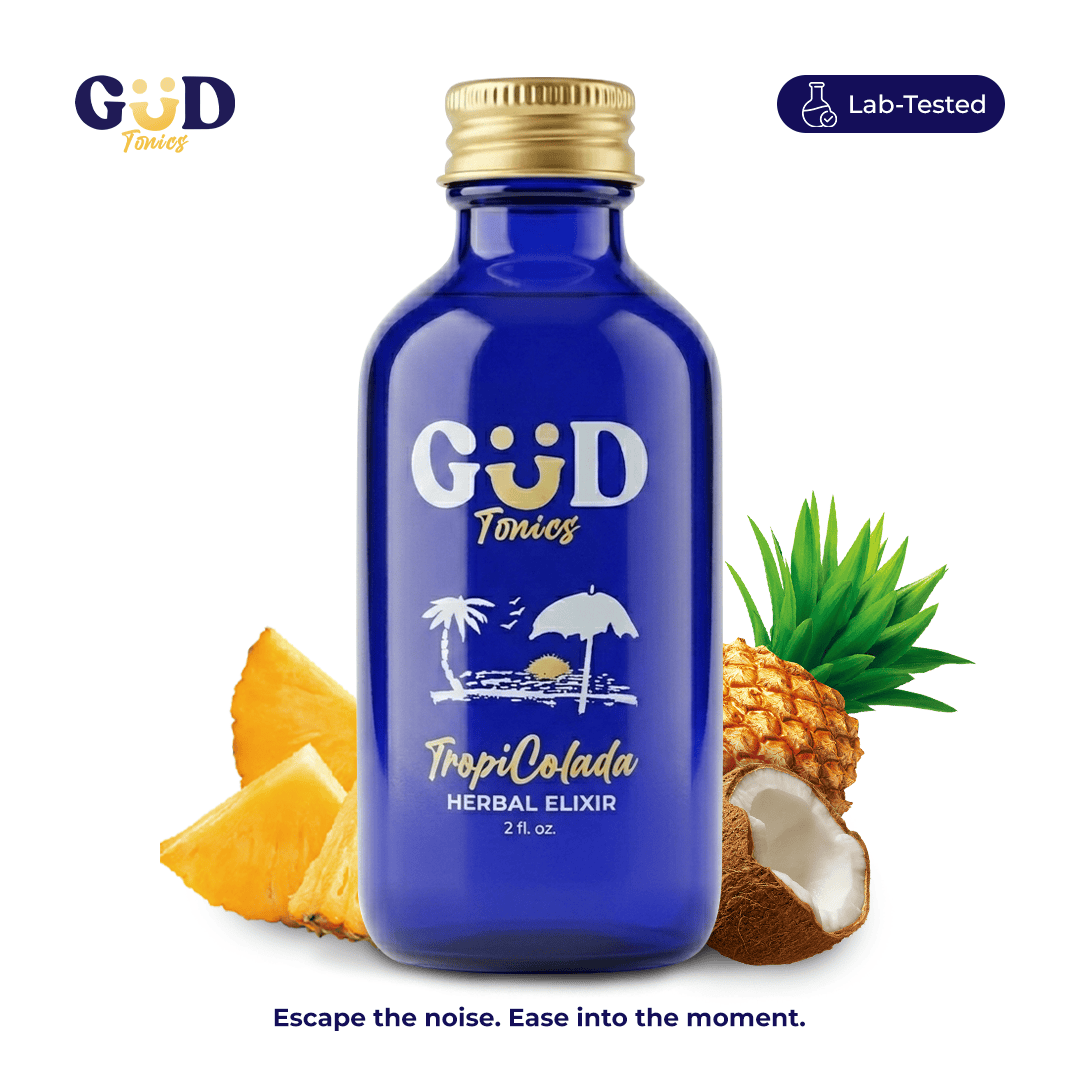
Take a kava forward tonic. Flavored, ready to drink, sold in a bottle. It is a beverage. We are not going to argue that a flavored liquid you swallow from a bottle is something other than a beverage merely because the word has become expensive, and any reader who has watched this category rename its way around a rule before should be suspicious of a company that tries it here.
A second format prohibition sits further down the same list. Subsection (a)(7) covers "a kratom product in any form that is combustible or intended to be used for vaporization, aerosolization, or injection." Same logic, different shapes. A kratom vape is out in Rhode Island however clean its panel is. So is anything you would light. So is anything you would draw into a syringe. No measurement is taken first, because no measurement would change the answer.
And subsection (c) closes the loop with a word that carries real weight: anything that fails to comply with subsection (a) "shall be deemed contraband." Not mislabeled. Not subject to a warning letter. Contraband, with a confiscation procedure written into the same chapter.
What Rhode Island counts as a kratom product
The prohibition only bites if the thing in your hand is a kratom product, so the definitions matter, and section 21-28.12-2 is short enough to read in five minutes. Kratom means any part of the leaf of the plant mitragyna speciosa. A kratom product means a product containing any part or extract of that leaf, and the definition then spells out that it includes concentrated forms "and products composed of kratom and other ingredients."
That last clause is the one aimed at blends. A drink built mostly of something else, with kratom in it, is a kratom product in Rhode Island. A kava forward tonic with kratom in it is exactly that.
The definitions section runs to fourteen terms, from contraband kratom products through synthesized material. Conventional food or beverage is not among them. Neither is serving, which matters a great deal for two of the numeric limits later in the chapter and not at all for the prohibition we are talking about here.
Where does that phrase come from, then? Federal food law, where the line between a conventional food and a dietary supplement has been argued over for decades. FDA has published a guidance for industry on distinguishing liquid dietary supplements from beverages, and it shows how much of that classification turns on presentation: the product name, the packaging, the serving size, the recommended conditions of use, and how the thing is marketed. Guidance is not binding, and a federal classification question is not the same question a Rhode Island court would be answering. The edges of the phrase are for the state to settle. But nobody is arguing about the middle of it, and a flavored two ounce bottle you drink cold is the middle of it.
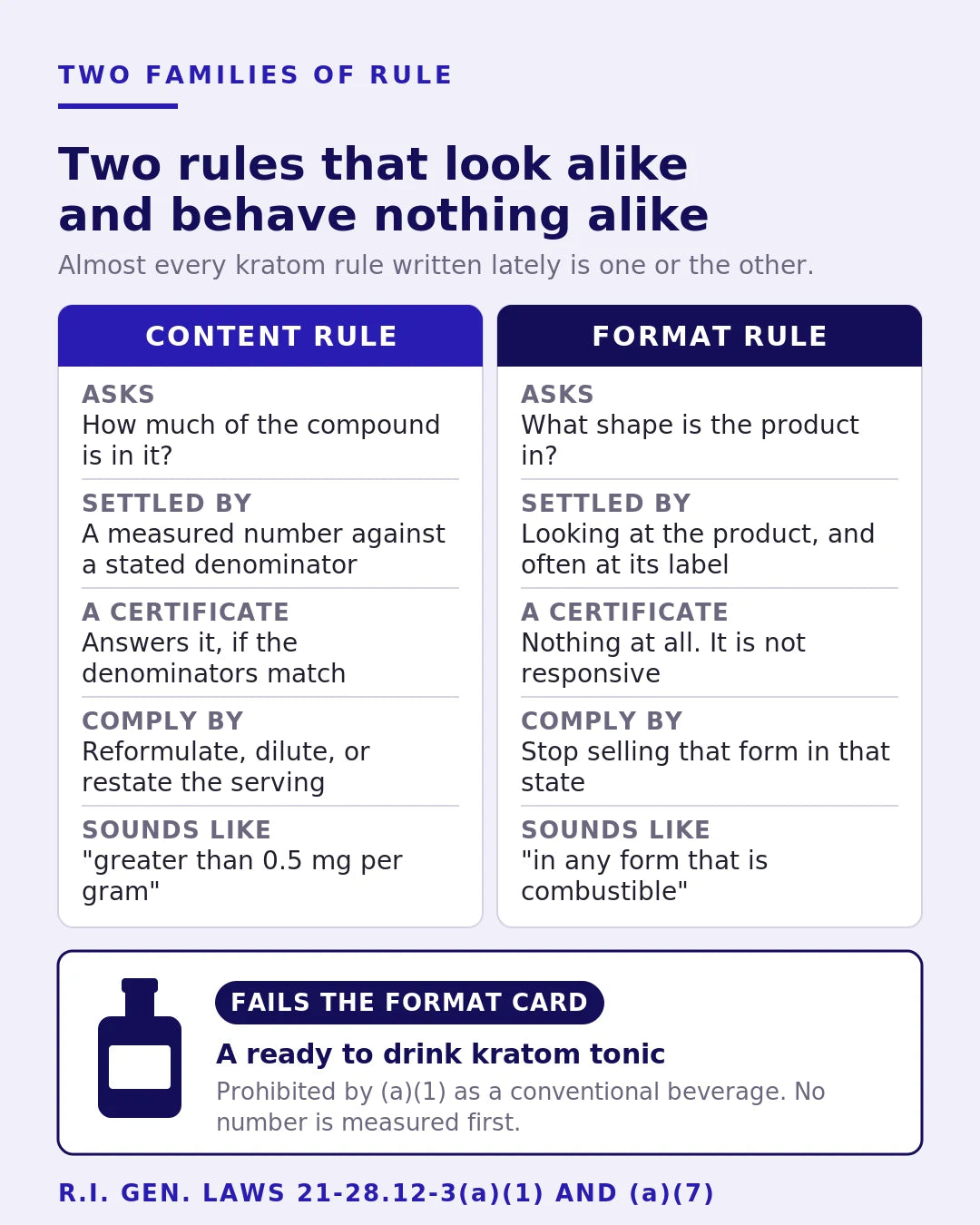
A content rule asks how much. A format rule asks what shape.
This is the part worth carrying out of the article, and it applies far beyond one state.
Almost every rule written about kratom in the last few years falls into one of two families, and they behave completely differently. A content rule sets a quantity and asks a laboratory to answer it. A format rule names a physical form and asks nothing of a laboratory at all. Sellers, buyers and a good deal of trade press treat these as the same animal, which is why you keep seeing a certificate of analysis produced as an answer to a question the certificate cannot address. How to read that certificate lives elsewhere.
| Content rule | Format rule | |
|---|---|---|
| The question it asks | How much of the compound is in it? | What shape is the product in? |
| What settles it | A measured number against a stated denominator | Looking at the product, and often at its label |
| What a certificate of analysis does | Answers it, if the denominators match | Nothing at all. It is not responsive |
| How a seller complies | Reformulate, dilute, or restate the serving | Stop selling that form in that state |
| Typical wording | "greater than 0.5 mg per gram" | "in any form that is combustible" |
So a product can pass every number in a statute and remain prohibited by that same statute. Read that twice if you sell anything. It is also true in the other direction, and that direction is the one that catches shoppers: clearing a federal threshold tells you nothing about a state that never asked a quantity question in the first place. The retail channel has noticed. NACS wants federal rules stating which products can and cannot be sold.
Rhode Island runs both at once
What makes the Rhode Island chapter such a useful teaching document is that it does not pick a side. It stacks both families in a single list, in no particular order, and a reader skimming for milligram figures will sail straight past the sentences that decide whether the product may exist there at all.
The format and presentation limbs of section 21-28.12-3(a):
- (a)(1) no kratom product that is, or is labeled as, a conventional food or beverage.
- (a)(7) nothing combustible, and nothing intended to be used for vaporization, aerosolization or injection.
- (a)(8) nothing that mimics a candy product, and nothing manufactured, packaged or advertised in a way that can reasonably be considered to appeal to people under twenty-one.
- (a)(9) child-resistant packaging meeting the standards in 16 C.F.R. 1700.15(b), tested in accordance with 16 C.F.R. 1700.20.
- (a)(12) a list of mandatory label lines, including a habit forming warning, a pregnancy and breastfeeding warning, a medication interaction warning, the FDA disclaimer, per serving and total alkaloid figures, and the manufacturer's physical address, which may not be a post office box.
The content limbs, in the same subsection:
- (a)(4) residual solvents no higher than U.S. Pharmacopeia 467 allows.
- (a)(5) no synthetic alkaloids, synthetic mitragynine among them. A flat prohibition with no threshold attached.
- (a)(6) heavy metals in parts per million, with arsenic under 2, cadmium under 0.82, lead under 1.2 and mercury under 0.4.
- (a)(10) no more than 150 mg of mitragynine per serving, and two further limits on the other alkaloid the chapter caps, 0.5 mg per gram and 1 mg per serving.
- (a)(11) no more than one percent of that same alkaloid as a percentage of total kratom alkaloids.
Then subsection (b) adds a third kind of requirement that is neither: retail sale only by a licensed retailer, sourcing only from a licensed manufacturer, importer or distributor. A product that is format clean and number clean and sold by someone without a license is still outside the law.
One footnote on the numbers, because it is genuinely interesting and it belongs to whoever sells concentrates. Two of the three limits in (a)(10) are written per serving, and the chapter never defines a serving, which means a manufacturer sets that denominator on its own label. The per gram limit is the one that does not move. A gram is a gram.
The federal notice is a content rule and nothing else
Look at the federal proposal next to the state statute and the difference is immediate. DEA's notice of intent of 6 July 2026, at 91 FR 40917, is titled "Schedules of Controlled Substance: Temporary Placement of 7-Hydroxymitragynine Above a Specified Threshold in Schedule I." It would reach material carrying more than 0.050 percent of that compound by weight, or more than 1.00 milligram of it in the article. Two numbers. That is the entire test.
It does not prohibit a beverage. It does not prohibit a tablet, a capsule, a powder, a gummy or a sublingual strip as such. It reaches material at or above a measured level, whatever container that material happens to be sitting in. See the status box above for where the proposal stands, and note that a filed notice is not a rule in force. Anyone telling you otherwise is either not reading carefully or is counting on you not to. A second temporary scheduling order, which took effect on 26 August 2026, names three derivatives outright and sets no threshold at all. Stricter, but still a content rule: it asks what is in the bottle, not what shape the bottle is.
Which gives you a clean practical rule. If the question is federal, the answer lives on a lab report matched to your lot. If the question is Rhode Island's beverage prohibition, the answer lives on the shelf, and no lab report will move it an inch. Those are not two versions of the same question and a seller who blurs them is doing you no favors.
Tennessee is a third thing entirely
Neither family covers what Tennessee did. House Bill 1649, carrying the name Matthew Davenport's Law, amends Title 33 chapter 2 and Titles 38, 39, 50, 63 and 68 of the Tennessee Code, and it was enacted as Public Chapter 950. The House passed it 78 to 9, with eight members present and not voting. The Senate passed it 23 to 2, with four present and not voting.
It is a category ban. The enacted law covers kratom in every form, leaf powder and capsules and teas and extracts alike, and its section 2 creates three offences: knowingly possessing kratom, knowingly manufacturing, delivering or selling it, and knowingly possessing it with intent to manufacture, deliver or sell. Possession is in there, not sale alone. There is no threshold to test against and no format to switch to. Before it, Tenn. Code section 39-17-452 permitted natural kratom for adults twenty-one and over. Reporting also describes criminal penalties attached to the new law. And it does more than prohibit: it requires medical examiners to test decedents for kratom in suspected overdose autopsies, and clinical toxicology for suspected overdose to include it.
Three states, one year, three directions. Rhode Island went from a ban to a licensed market with a very tight rulebook. Tennessee went from a permitted adult market to a total prohibition. North Dakota closed everything by executive order on 5 August 2026 and handed the question to a special session. If you are trying to hold a national picture in your head, that set is the correction: there is no trend line here to follow, only individual documents to read.
Our own front label is a gap, and it is ours to name
Now the part a marketing department would cut.
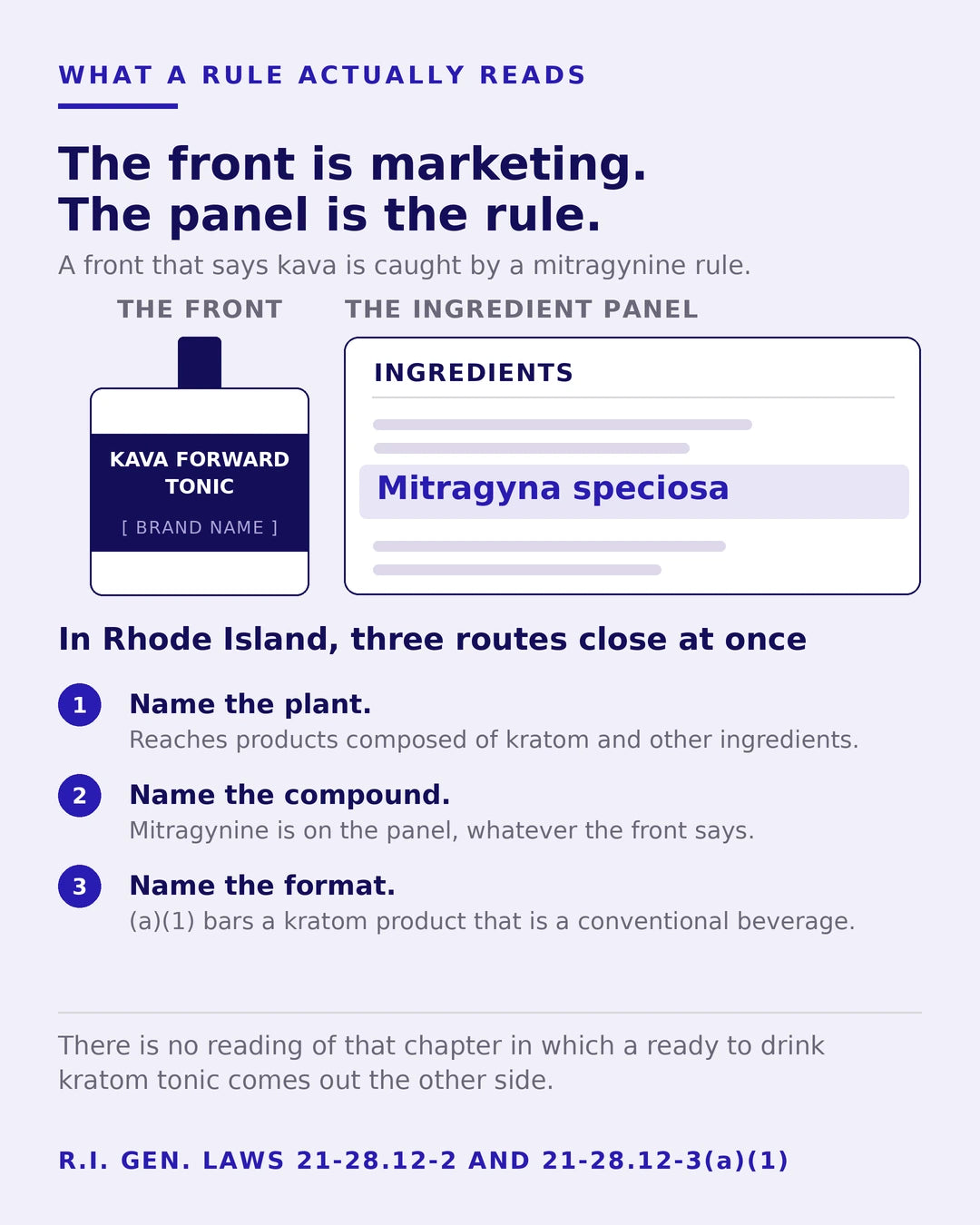
GUD Tonics reads as a kava brand. The brand name suggests kava. The flavor names suggest a tropical drink. The product names put kava first. And the ingredient panel says Mitragyna speciosa. Somebody who reads the front of our bottle and stops there could walk away believing they bought a kava drink, and that person would be holding a kratom product. We would rather say that ourselves than have somebody else say it about us.
It matters most where a rule is written by compound rather than by plant. DEA's own kratom fact sheet names mitragynine as one of the two major psychoactive ingredients in the leaf, and when a drafter wants to reach the active material rather than the botany, that is the word they reach for. A bottle whose front says kava is caught by a mitragynine rule anyway. The plant name on the front is not an operative fact anywhere. The alkaloid on the panel is.
And in Rhode Island both routes close at once, which is worth being precise about rather than leaving as an impression. Name the plant, and the definition of a kratom product reaches "products composed of kratom and other ingredients," so a kava forward blend is in. Name the compound, and anything carrying Mitragyna speciosa on its panel is in. Then the format prohibition applies on top of both. There is no reading of that chapter in which a ready to drink kratom tonic comes out the other side.
Our raw kava extract powder is a different product and answers a different question, since it contains no Mitragyna speciosa at all and so is not a kratom product under Rhode Island's definition. That is not a side door for the tonics and we are not offering it as one. Kava carries its own separate rules in some places, and tracing those is a different article.
How to tell which kind of rule you are reading
You do not need a lawyer for the first pass, and the first pass is usually enough to tell you whether you have a problem. Open the actual text, not somebody's summary of it, and ask five questions in this order.
- What does it name? The plant, the compound, or a product category. A rule that names mitragynine reaches products whose front label never mentions kratom. A rule that names the plant may still reach blends, depending on how the definition is drafted, so read the definition rather than the headline.
- Does it prohibit a form outright? Look for the format words. "In any form", "conventional food or beverage", "combustible", "intended to be used for", "mimics a candy product". Those phrases are doing something a number cannot do.
- Does it set a number, and per what? Milligrams per serving, milligrams per gram, percent by weight, percent of total alkaloids. Four denominators, and one certificate can produce four different answers depending on which one you apply to it.
- What are the operative verbs? Sale and distribution are rules for the seller. Possession and use are rules for you. Rhode Island's list opens with prepare, distribute, sell, possess or advertise, which is broad on purpose.
- Who needs a license, and does anyone have one yet? A licensing regime that exists on paper is not the same as a licensing regime that is issuing.
One more, for anyone crossing a state line with something in the car. A summary written by a website that sells kratom, ours included, is not a source. Find the state's own text.
If something goes wrong
Save these before you need them rather than after. Poison Control is free, staffed and open around the clock at 1-800-222-1222. For dependence, treatment referral or a question you would rather not ask a stranger in person, the SAMHSA National Helpline is free and confidential at 1-800-662-4357. Call 911 if somebody is hard to wake, is not breathing normally, or is unresponsive.
And one thing we will not sell you, in a category where it gets sold constantly. Kratom is not a treatment for opioid use disorder or for withdrawal, and neither is kava. The medicines with an evidence base behind them are buprenorphine, methadone and naltrexone, and that conversation belongs with a clinician rather than with a brand.
Frequently asked questions
Are kratom drinks legal in Rhode Island?
No. R.I. Gen. Laws section 21-28.12-3(a)(1) prohibits a kratom product that is a conventional food or beverage or labeled as a conventional food or beverage product. A ready to drink bottle is a beverage, so the format is prohibited there whatever the lab report says. That reaches every ready to drink kratom beverage without exception.
What is the difference between a format rule and a content rule?
A content rule asks how much of a compound is in the product and is settled by a laboratory number. A format rule asks what shape the product is in and is settled by looking at the product. A certificate of analysis answers the first kind of question and is simply not responsive to the second.
My drink says kava on the front. Does a kratom law apply to it?
It does, if the panel lists Mitragyna speciosa. Where a rule names the compound mitragynine rather than the plant kratom, a bottle whose front says kava is caught anyway, because the operative fact is what is in the bottle. Read the ingredient panel, not the brand name.
Does passing a lab test mean a product is legal?
No. A product can clear every threshold in a statute and still be prohibited by that same statute, because some of the prohibitions are not about quantity at all. Rhode Island prohibits kratom beverages, kratom vapes and anything combustible before any measurement is taken.
Does the Rhode Island Kratom Act define a serving?
The definitions section of the chapter, section 21-28.12-2, defines fourteen terms and serving is not among them. Two of the numeric limits are stated per serving. The limit stated per gram does not depend on how a label is written.
How do I tell which kind of rule applies where I live?
Read the text rather than a summary of it, and ask four things. What does it name, the plant or the compound or a product category? Does it prohibit a form outright? Does it set a number, and per what denominator? And which verbs does it use, since sale is a rule for the seller and possession is a rule for you.
What to do with the bottle you already own
Four things, and none of them takes long.
- Turn the bottle around and read the ingredient panel, whatever the front says. If Mitragyna speciosa appears, you are holding a kratom product for the purposes of most rules that mention it.
- Find the lot code, then find the report for that lot. Ours are posted on our lab results page, per lot, with the full alkaloid panel shown, including the lines that are awkward for us.
- Ask your state's rule which kind it is before you ask a number. If it prohibits a form, the report is beside the point.
- Do not carry product into a state you have not checked, and remember that possession language reaches you and not just whoever sold it.
If your state has already closed, the answer is not a checkout. We do not ship these tonics to Rhode Island, and our shipping policy is where that list lives. Tennessee and North Dakota prohibit kratom in every form, so a bottle listing Mitragyna speciosa has no lawful home in either. Wherever you are, open your own state's rule first, and then the panel for your lot on our lab results page.
Rhode Island is the proof that a kratom ban can be undone. It is also the proof that the law which replaces one can be stricter than the ban's opponents expected, and can close a format the industry never imagined was on the table. Both halves are the story. A company that told you only the first half would be advertising.
This article is for general information and is not legal or medical advice. Laws governing kratom and its alkaloids differ by state and by locality and change frequently, so verify the current rules where you live and consult qualified counsel for compliance questions. These statements have not been evaluated by the Food and Drug Administration. GUD Tonics products are not intended to diagnose, treat, cure or prevent any disease, and are intended for adults 21 and over.