Two kratom drinks standing side by side on the same counter can differ by a factor of several hundred in the only ingredient that does anything, and the front of the bottle almost never tells you which one you are holding. One document closes that gap and only one. It is the certificate of analysis, the laboratory report on a specific batch, and most people who open one look at it for three seconds and take the existence of a PDF as the answer. This guide is about the rest of the page: how to match a report to the lot code on the bottle in your hand, the six checks that take under a minute, the column that is misread more than any other, and what our own reports say, including the parts that are awkward for us.
The two rows that decide everything
You do not need any chemistry to read one of these documents, but you do need to know which two rows to find first. Kratom leaf carries many alkaloids and two of them do most of the pharmacological work. DEA's kratom fact sheet names mitragynine and 7-hydroxymitragynine as the major psychoactive constituents. Mitragynine is the abundant one. 7-OH sits in raw leaf at trace levels and is also produced in the body when mitragynine is metabolized, which is one reason the two are so hard to untangle in overdose data. If you want the compound rather than the marketing name, 7-OH is PubChem CID 44301524, molecular formula C23H30N2O5, and that record is the analyte a laboratory quantifies when it prints the row. Everything below comes back to those two rows and the units printed beside them.
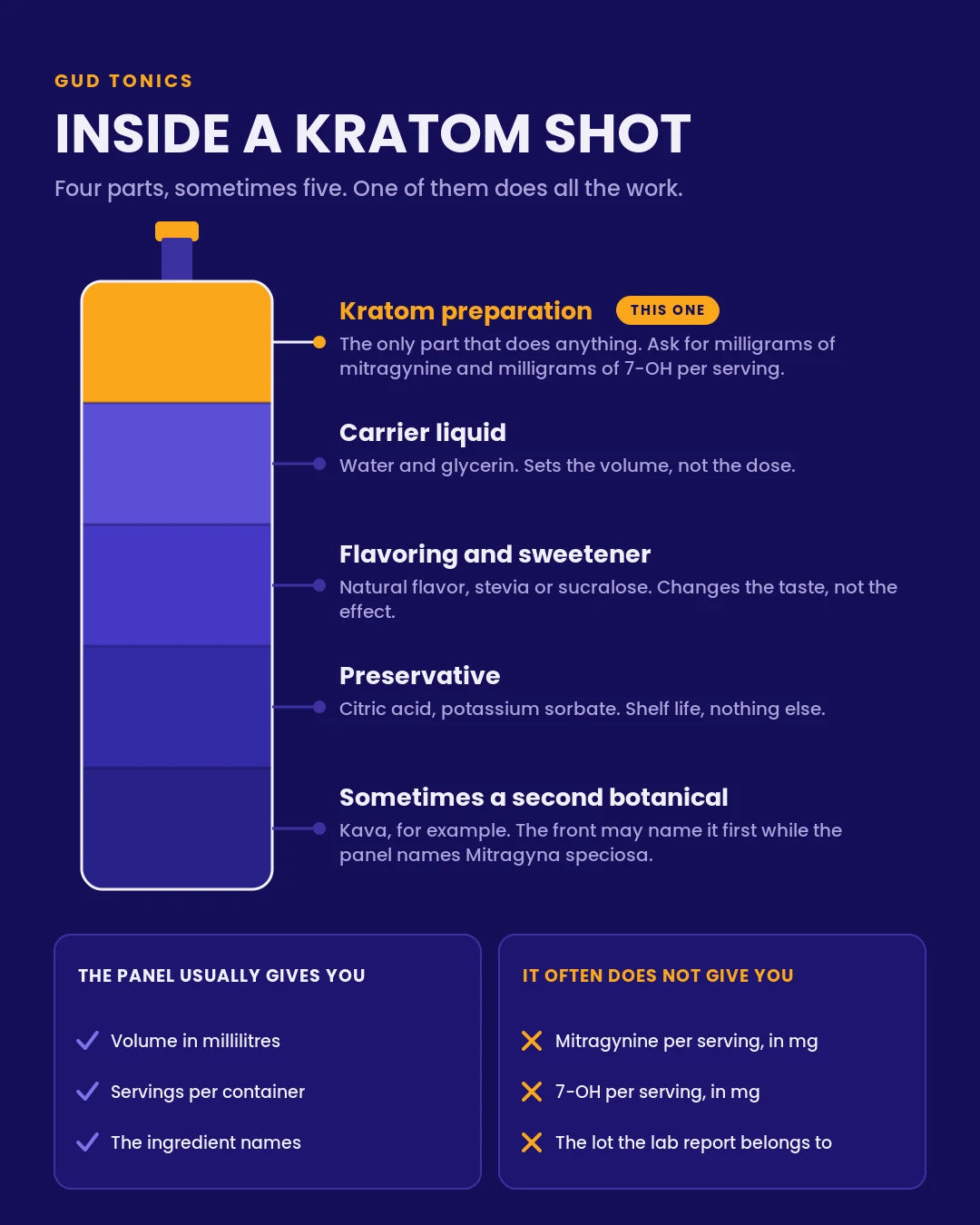
What surrounds them is scaffolding. Strip the marketing off a bottle and you have four parts, a kratom preparation, a carrier liquid, flavoring and sweetener, and a preservative, and only the first one does anything at all. This article is not about the format. It starts one step later, at the paperwork.
One correction before we go further, because it cuts against our own category. Shots are not the dominant format in this market. DEA lists liquid oral beverages, its own words for shots, alongside tablets, capsules, powders, syrups, vapes, sublingual strips and nasal sprays. Describing an investigation that identified 250 products sold between September 2024 and February 2025, the notice reports that chewable and sublingual tablets were the most common formulation. We sell shots. We are not going to tell you the format you are holding is uniquely safe or uniquely dangerous, because the evidence does not organize itself by format. It organizes itself by contents.
The 700-fold problem
Here is the single most useful number in this article. In that same investigation, summarized in the Federal Register notice above, the concentration of 7-OH products ranged from 1 mg to 700 mg in a single dose or serving. One milligram to seven hundred. That is not a spread, it is a different product category at each end, at an average of about four dollars a dose.
DEA describes the market it found in blunt terms: products "often characterized by ambiguous dosages and misleading marketing, frequently being labeled as 'natural M. speciosa extracts'", with "essential information regarding their purity, identity, quantity and long-term safety" unknown. Read that twice. The agency is not saying the labels are wrong about the plant. It is saying the labels do not carry a usable quantity.
Why the front of the bottle and the inside of the bottle come apart
There are three separate failures here and they get muddled together constantly, so it is worth separating them.
The first is silence. A label that says "kratom extract, 15 mL" is not lying. It simply does not answer the question. Without a milligram figure for mitragynine, the buyer has no way to compare it to anything, including the last bottle they bought.
The second is misdescription. FDA put this plainly on 29 July 2025, announcing its recommendation to schedule certain 7-OH products: these products "may not be clearly or accurately labeled as to their 7-OH content and are sometimes disguised or marketed as kratom." In June 2025 the agency issued warning letters to seven companies over 7-OH products including tablets, gummies, drink mixes and shots. FDA also said it was particularly concerned about products that may be especially appealing to children and teenagers, naming fruit flavored gummies and ice cream cones. State enforcers have come at the same problem from the consumer protection side. Missouri Attorney General Catherine Hanaway issued civil investigative demands, which are essentially subpoenas, to six companies her office described as the "major points of sale" for 7-OH and ordinary kratom in that state, demanding lab results, safety research and label information. Consumers, she said in a press release, may be "exposed to unapproved, unsafe and deceptively marketed opioid-like drugs." Note what that phrase does and does not say. Points of sale is a statement about reach, not about size.
The third is adulteration. Texas health officials have been the most specific of any state agency. In an alert on serious illnesses associated with 7-OH use, the Texas Department of State Health Services wrote that while kratom products typically carry low 7-OH concentrations, semi-synthetic or synthetic 7-OH products have concentrations up to 98 percent 7-OH, and that "concentrated 7-OH is often added to kratom products." Texas also puts 7-OH at up to 13 times the potency of morphine. That number is older than the alert and it is not the state's own: it traces to a 2004 paper by Matsumoto and colleagues, and it appears in FDA's own scientific report, where it describes a single in vitro assay on isolated guinea pig tissue rather than the drug in general. DEA's notice does not use it. And the mismatch is not always about 7-OH at all. In an enforcement operation reported by KAKE, Kansas Alcoholic Beverage Control agents seized 1,006 bottles of OPMS kratom extract liquid from twelve vape shops after a federal forensic laboratory measured the contents at 15.7 to 16.1 percent ethanol, which made them alcoholic beverages under state law. Those bottles were sold as shots. Nothing on the shelf said alcohol.
Independent chemistry backs the adulteration point. In the Journal of AOAC International in January 2026, Brown, Chan, Zhang and Brendler analyzed commercial products all described on their labels as "kratom extracts" and found 7-OH at 22 to 75 mg per gram, between 5 and 28 percent higher than the label claimed, with mitragynine far below what authentic leaf carries and chromatographic profiles inconsistent with kratom leaf. Their conclusion was that the products were "not kratom extracts, as labeled, but rather synthetic derivatives". We should disclose that two of those authors work as regulatory consultants on botanical dietary ingredients including kratom, which they state in the paper. The finding helps sellers of leaf products, us included. Weigh it accordingly, and note that it is the label mismatch, not the plant, that the analysis actually establishes.
The label first, because it is free
You can do most of this in the aisle, in about forty seconds, without knowing any chemistry.
| What the label says | What it actually tells you | What to do |
|---|---|---|
| "Kratom extract" | That the leaf was processed. Nothing about quantity, and DEA specifically flags this phrasing as common on high 7-OH products. | Keep reading. If no milligram figure appears anywhere, put it down. |
| "50x" or "100x" | A ratio to an unnamed starting material. It is not a dose and no standard defines it. | Ignore the multiplier entirely. |
| "Full spectrum", "premium", "proprietary blend" | Nothing measurable. None of these terms has a legal definition here. | Treat as decoration. |
| Servings per container | The most skipped line on the bottle. A single small bottle is frequently two servings. | Find it before you find anything else, because every other number depends on it. |
| Total milligrams of extract | The mass of material, not the mass of active alkaloid. A 5,000 mg extract figure says almost nothing. | Look for the alkaloid line instead. |
| Milligrams of mitragynine | The number that actually lets you compare two products. | Note whether it is per serving or per bottle. They are usually different. |
| 7-OH content | Often simply absent, which FDA has identified as a pattern rather than an accident. | Absence is information. Ask for the lab report. |
| Lot number, batch code, QR | The only mechanism that connects the bottle in your hand to a specific test. | No lot, no verification. That is a hard stop. |
Six checks on a certificate, in order
A certificate of analysis, usually called a COA, is where the real numbers live. Most brands now link one. Far fewer readers open it, and of those who do, most look at it for three seconds and take the presence of a PDF as the answer. The document rewards more attention than that.
Six things to check, in order.
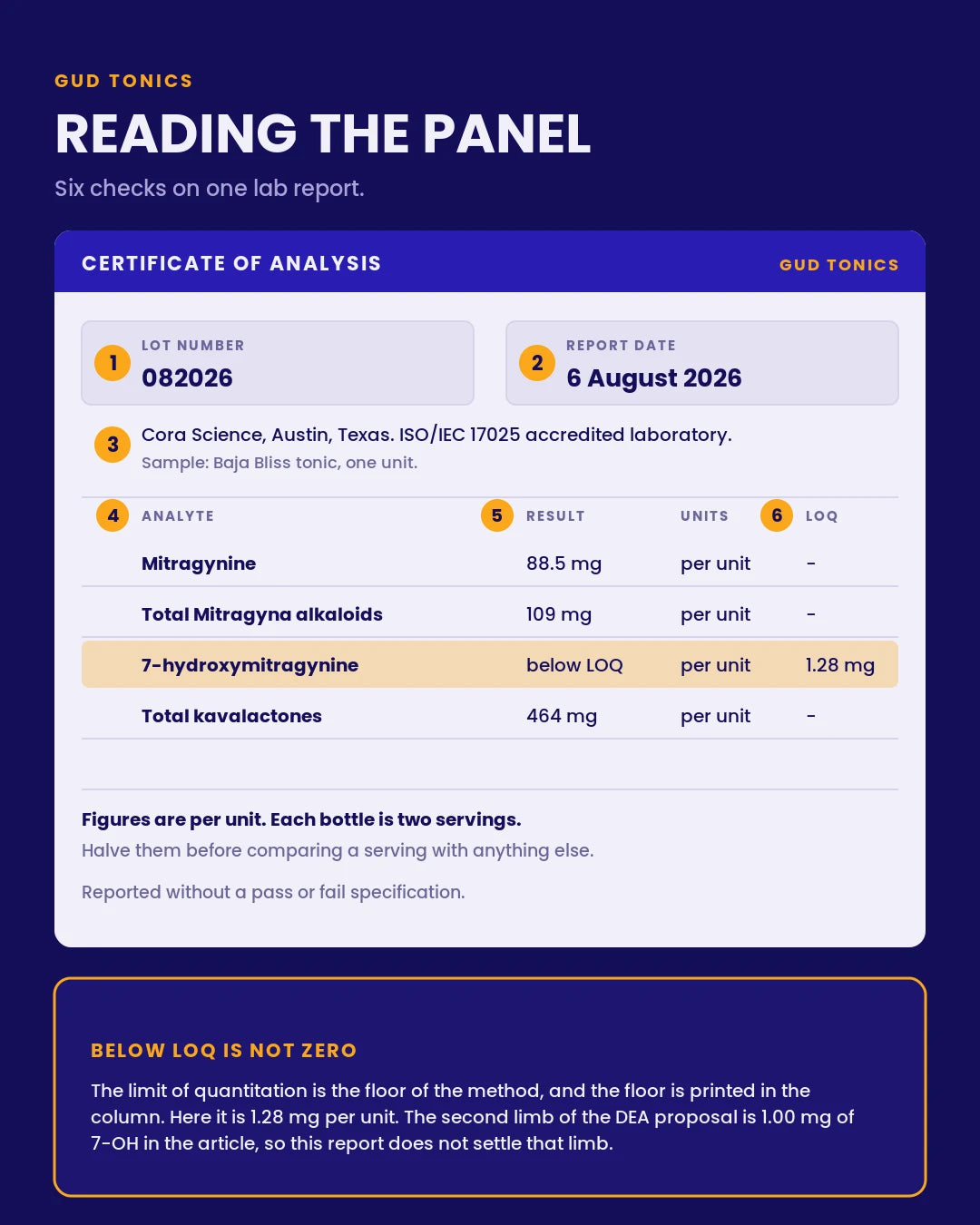
- Does the lot on the report match the lot on the bottle? A COA for a different batch is a document about a product you did not buy.
- What is the date? A report from two years ago describes two-year-old material.
- Which alkaloids were tested? A panel that reports mitragynine and stops has not answered the 7-OH question at all.
- What are the units? Milligrams per unit, milligrams per serving and percentage by weight are three different statements. A product can look reassuring in one and alarming in another.
- What is the limit of quantitation? This is the LOQ column, and it is the most misread number on any COA. A result printed as "below LOQ" does not mean zero. It means the instrument could not measure below that floor, and the floor itself is printed right there.
- Is the lab accredited, and is it independent? Look for ISO/IEC 17025 and an accreditation number, and check that the lab is not the manufacturer.
The LOQ point deserves an extra sentence because it is where honest brands and careless ones look identical on paper. If a report says a compound is below a limit of quantitation of 1.28 mg, and the threshold you care about is 1.00 mg, then the report has not settled your question, however clean it looks, and anyone who tells you otherwise is either not reading the column or is counting on you not to.
What our own bottles say, and what they do not
Now the part that would be easy to leave out.
GUD Tonics sells a kava forward tonic that also contains kratom. The brand reads as kava. The flavor names read as kava. The product name puts kava first. And the ingredient side says Mitragyna speciosa. A shopper who reads the front of our bottle and nothing else could reasonably walk away believing they bought a kava drink, and that shopper would be holding something that is also a kratom product. That is exactly the shape of gap this article is teaching you to catch, and it is on our own label, so we are naming it rather than waiting for somebody else to.
This matters most where the law is written by compound rather than by plant. When a state, a city or a federal notice names mitragynine instead of "kratom", a bottle whose front says kava is covered anyway. The plant name on the front is not the operative fact. The alkaloid on the panel is.
So here is what our reports actually say. All three tonics in lot 082026 were tested by Cora Science in Austin, Texas, an ISO/IEC 17025 accredited laboratory, with a report date of 6 August 2026. Every one of these certificates is posted on our lab results page, and the figures below are copied from them.
| Lot 082026, per unit | Mitragynine | Total Mitragyna alkaloids | 7-OH | Total kavalactones |
|---|---|---|---|---|
| Baja Bliss | 88.5 mg | 109 mg | below LOQ of 1.28 mg | 464 mg |
| Pink Sunset | 87.7 mg | 107 mg | below LOQ of 1.29 mg | 546 mg |
| TropiColada | 87.4 mg | 107 mg | below LOQ of 1.28 mg | 559 mg |
Four honest observations about our own table, in the spirit of the rest of this piece.
First, those figures are per unit, and our product pages state that each bottle is two servings, so a reader who drinks half a bottle has taken roughly half of the number printed above. Divide before you compare us to anything else. Second, the certificate reports the alkaloids without setting a pass or fail specification against them, which means the document tells you what is in the bottle rather than certifying that it met a target. Third, the 7-OH line reads "below LOQ", and by the standard set out earlier in this article, that phrase does not mean zero: on the percentage basis the limit sits at 0.0020 percent, far under the 0.050 percent figure in the DEA notice, while on the milligram basis the limit is 1.28 mg per unit, which is above the 1.00 mg figure in the same notice. One route is answered by this report and the other is not resolved by it. That gap is ours to name rather than to paper over, and we claim no exemption from an order that has not published; where that reading lands is a question for a laboratory with a lower detection limit and for counsel, not for a blog post.
Fourth, one certificate on that page is a different kind of document altogether. Our raw kava extract powder carries a supplier ingredient specification: species identity as Piper methysticum, root, origin Vanuatu, kavalactones at 30.28 percent, heavy metals, pesticides and microbial results. It is a legitimate document and it answers questions about the raw material. It is not a finished product alkaloid panel and it does not test for Mitragyna alkaloids at all. Two documents, both real, answering different questions. Knowing which one you are looking at is most of the skill.
The objections we have to answer
A guide written by a company that sells kratom shots should state the strongest arguments against itself. Four of them.
"Naturally derived is different from synthetic." Not pharmacologically, and DEA said so in advance. The notice states that "the chemical structures of synthetic and naturally occurring 7-hydroxymitragynine are identical" and that the "pharmacological profile, receptor affinity, and mechanism of action" therefore "remain unchanged regardless of its source." A brand that answers a potency question with the word natural has not answered it.
"The proposed threshold is aimed at other people." It is not. The notice reaches material derived from Mitragyna speciosa and further processed into "extracts, concentrates, processed edibles, or pressed pills". That language describes ordinary extract products, ours included, and any seller claiming otherwise should be asked to point at the sentence that exempts them.
"Regulators have blessed leaf." FDA has said its 7-OH action is not aimed at natural leaf carrying only trace levels. That is a narrow statement and it is not an endorsement, since the agency continues to raise concerns about kratom products more broadly. Do not let anyone stretch it into approval.
"The harm data belongs to somebody else's products." Nobody can prove that, including us. Federal surveillance data cannot reliably separate traditional leaf from concentrated or semi-synthetic formulations, which means a leaf seller pointing at an extract seller is making an argument the underlying data does not support.
What survives all four is narrower and, we think, more useful: the harm in this category concentrates where the label does not match the contents. That claim is supported by FDA, by DEA and by independent chemistry, and it does not require us to assert that leaf is safe, that shots are safe, or that our own bottles are exempt from anything.
If something goes wrong
Save these before you need them. Poison Control, staffed and free, 24 hours a day: 1-800-222-1222, or through America's Poison Centers. For substance use, treatment referral and dependence questions, the SAMHSA National Helpline is free and confidential at 1-800-662-4357.
Call 911 if someone is difficult to wake, is not breathing normally, or is unresponsive. Naloxone reverses opioid type respiratory depression, and the case table in DEA's notice records a 29 year old whose cardiopulmonary arrest was reversed with naloxone after reported 7-OH use, so keeping it in the house is reasonable if concentrated products are around. Naloxone nasal spray is sold over the counter.
One thing we will not do is sell you a treatment story. Kratom is not a treatment for opioid use disorder or for withdrawal, and neither is kava. The medicines with an evidence base are buprenorphine, methadone and naltrexone, and that conversation belongs with a clinician.
Frequently asked questions
Is a liquid extract stronger than kratom powder?
Not inherently. A shot is a format, not a potency class. A liquid extract can carry more alkaloid per swallow than a spoon of leaf powder, or less, and only the milligram figure settles it. Compare the mitragynine number per serving, never the bottle size.
How much mitragynine is in a typical kratom drink?
There is no typical, and that is the honest answer rather than a dodge. Our own lot 082026 tonics report about 88 mg of mitragynine per bottle, across two servings, and that number tells you nothing whatsoever about anybody else's bottle. Only a lab report matched to the lot in your hand settles it.
Do kratom drinks contain 7-OH?
Leaf material carries it in trace amounts naturally. Some commercial products carry far more, either because the material was processed or because concentrated 7-OH was added, which Texas health officials describe as a common practice. If the panel is silent on 7-OH, the lab report is the only place to look.
What does "below LOQ" mean on a kratom lab report?
It means the compound was under the lowest concentration the method could reliably quantify, and that floor is printed in the same row. It does not mean none was present. Always read the number next to the phrase.
Are kratom drinks legal?
Kratom legality is set state by state and sometimes city by city, and some jurisdictions regulate by naming the compound mitragynine rather than the plant. Check your own state and your own municipality before you buy, and remember that a product whose front label names a different botanical can still be covered.
What to do before you buy your next bottle
Four steps, in order, and they take under a minute once you have done them once.
- Find servings per container first, then find the mitragynine figure, then work out the per serving number yourself.
- Find the lot code on the bottle and match it to a lab report. If the brand cannot produce one for that lot, that is your answer.
- On the report, check the date, the alkaloid list, the units and the LOQ column.
- Check your own state and city rules, and check whether they name the plant or the compound.
If you want the regulatory background rather than the label mechanics, our explainer on what the 7-OH ban means for kratom drinks covers the federal proposal in detail and is updated as it moves. Every certificate behind our own numbers sits on the lab results page linked above, lot by lot, including the lines that are inconvenient. And if you want to apply all of this to a bottle rather than to a hypothetical, the full range is in the GUD Tonics shop, where every product listing states its servings per container and links to its own certificate.
Read the panel. Then read the report. Then decide.
This article is for general information and is not legal or medical advice. Laws governing kratom, mitragynine and 7-hydroxymitragynine differ by state and by locality and change frequently, so verify current rules where you live and consult qualified counsel for compliance questions. These statements have not been evaluated by the Food and Drug Administration. GUD Tonics products are not intended to diagnose, treat, cure or prevent any disease, and are intended for adults 21 and over.