Listen to this page
Read by an AI voice. The full article is read aloud, top to bottom, including the help lines and both boxes. The four tables and the two images are on the page. Lot and docket numbers are read out digit by digit.
Help first. If someone is difficult to wake, is not breathing normally, is having a seizure, or is unresponsive, call 911.
Anywhere in the United States: Poison Control on 1-800-222-1222, around the clock, for a reaction that worries you after any kratom or kava drink, ours included. The 988 crisis lifeline, by call or text. The federal treatment locator is findtreatment.gov.
Kratom is not a treatment for opioid use disorder, or for opioid or kratom withdrawal, and neither is any kratom drink, ours included. Buprenorphine, methadone and naltrexone are the medicines with the evidence base for opioid use disorder, prescribed by a clinician. Clinical questions belong with a clinician who can see you. Not with us.
Kratom drinks sit under more rules than their size suggests. FDA's position is that kratom cannot lawfully be added to conventional foods. DEA has proposed a federal limit with a line written for liquids. Three compounds, MGPI, MGM-15 and MGM-16, were temporarily placed in Schedule I in any amount on August 26, 2026. And some states go further, Rhode Island barring any kratom beverage by its format alone.
This guide takes those layers in turn, in the documents' own words, then shows what a label and a lab certificate can and cannot tell you. We have a stake: GUD Tonics sells kava drinks that also contain kratom, and we say what our own certificates report and leave out.
Checked November 5, 2026: the Federal Register, the pages cited here, and our own product pages and certificates.
Who wrote it. GUD Tonics, which sells three ready-to-drink kava tonics that also contain kratom (Mitragyna speciosa), a bundle, and a raw kava extract powder. This article does not say whether our drinks would meet DEA's proposed test.
Federal status as of November 5, 2026. Proposed, not law: DEA's October 14, 2026 notice (FR Doc 2026-20943) would control the concentrated minor alkaloid and MGPI above "1 milligram per milliliter (for liquid preparations)" or when the mitragynine ratio "is less than 100". Any order would be published "on or after November 13, 2026": a floor, not a start date. July's "on or after August 5, 2026" passed with no order, and our searches on November 5, 2026 found none under the October notices. In force since August 26, 2026: MGPI, MGM-15 and MGM-16 temporarily in Schedule I in any quantity (FR Doc 2026-17429).
State dates. Rhode Island's bar on kratom food and beverage products: since April 1, 2026. New York: age 21 since June 17, 2026; label law from December 19, 2026. Minnesota: age 21 since August 1, 2026. Tennessee's and Kansas' bans: since July 1, 2026. Massachusetts' emergency order: from August 28, 2026, for up to a year.
No affiliate links. Corrections: through our contact page. Next review February 5, 2027, or the day DEA publishes an order.
Kratom drinks under federal food law, in FDA's words
Start with the agency that regulates food. FDA's page on kratom never uses the words "beverage" or "drink", but its conclusion covers food in general: kratom "is not lawfully marketed as a dietary supplement and cannot be lawfully added to conventional foods." The reason: FDA has "determined that kratom, when added to food, is an unsafe food additive within the meaning of section 409", which makes food containing it adulterated.
FDA has applied that reasoning to a drink mix. In a warning letter dated June 25, 2025, it called a kratom drink mix "a multi-ingredient food" and wrote: "Kratom extract is not approved for use in any conventional food." Claims are a separate problem: in 2023, FDA told a seller of kratom and kava shots that its products were "unapproved new drugs under section 505(a)", noting they were marketed "for the treatment or cure of opioid addiction and withdrawal symptoms." A warning letter is FDA's notice to a company, not a court ruling.
None of this is a criminal ban or a scheduling order. It is a regulatory determination, enforced case by case. FDA also "has warned consumers not to use kratom because of the risk of serious adverse events, including liver toxicity, seizures, and substance use disorder (SUD)."
Researchers have noticed the drinks. In a commentary in Public Health Reports, published online January 12, 2026, economists Teresa Perry and Sayorn Chin write that "many kratom drinks contain kava and kratom" and that "the rapid expansion of the kratom beverage industry has outpaced regulators, researchers, and health professionals." It is a commentary, not a study. One line in it says no federal agency regulates kratom; FDA's own determinations, above, say otherwise.
The proposed federal limit for liquids, in DEA's own words
On October 14, 2026, the Federal Register published a DEA notice of intent, FR Doc 2026-20943 (91 FR 65370), which the Justice Department had announced on October 9. It proposes temporary Schedule I control, above a threshold, of the minor alkaloid, which the Justice Department, citing HHS, says occurs naturally in botanical kratom "at relatively low levels", and of mitragynine pseudoindoxyl (MGPI).
A notice of intent is not an order, and the test binds no one unless DEA publishes one. In the proposed regulation's own words:
| Limb | The notice's words | What a lab would have to measure | What the notice does not say |
|---|---|---|---|
| (A) Concentration | "greater than 1 milligram per milliliter (for liquid preparations)". For solids, "greater than 1 milligram per gram". | The minor alkaloid and MGPI, alone or combined, per milliliter. | What counts as a liquid preparation. Any limit per bottle, per container or per serving. |
| (B) Ratio | "The mass of mitragynine present" divided by the minor alkaloid, by MGPI or by both combined "is less than 100". | Measured amounts of all three. | Any exception for a product that passes limb (A). |
Either limb is enough: they are joined by "or". The notice does not define "liquid preparations" at all, and it is silent on how drink mixes, syrups, gels and concentrates are classed, so whether a drink mix sold as a powder counts as a solid or a liquid is a question it leaves open.
Why a threshold? The notice says both substances "have supposedly been found in trace amounts in some botanical kratom products". Below the line is still not a safety finding. In the notice's words, "neither HHS nor DEA has made a finding that these substances are safe to use at below-threshold levels."
If you read about a 0.050 percent line or a limit of 1.00 milligram "in the article", that was DEA's July 6, 2026 notice, which the October notice says DEA "is withdrawing" (we did not find the separate withdrawal document). The July notice said an order would come "on or after August 5, 2026." None did.
When could an order come? Federal law, 21 U.S.C. 811(h), bars one until 30 days after the notice is published and 30 days after it is sent to HHS. By our count those periods end on November 13 and November 7, and the later date controls, which is why the notice says the order "will be published in the Federal Register on or after November 13, 2026."
That is a floor, not a start date. Nothing happens on November 13 unless an order is published; if one is, "it will take effect on the date the order is published in the Federal Register" and last two years, with a possible one-year extension. The notice says notice-and-comment rules do not apply to it, and such orders "are not subject to judicial review." The notice also says DEA's intent to control the minor alkaloid "does not preempt more restrictive state law".
What is already unlawful in any kratom beverage
The proposal is not the whole federal picture. On August 26, 2026, a temporary scheduling order (FR Doc 2026-17429, 91 FR 54948) placed MGPI, MGM-15 and MGM-16 in Schedule I with no threshold and no exception for drinks: "Possession of any quantity of mitragynine pseudoindoxyl, MGM-15, or MGM-16 in a manner not authorized by the CSA on or after August 26, 2026 is unlawful". It runs "until August 26, 2028" unless DEA extends it, makes it permanent or replaces it.

Read plainly, while that order stands, a drink containing any quantity of the three is a product containing a Schedule I substance. That is our reading of the words, not legal advice. Liquids are part of this. DEA's October notice says MGPI products "are commonly sold in different forms such as powders, tablets, and liquid shots", and of the MGPI products sold online in a study it cites, "18 percent were liquids (9 of 51)".
What about trace MGPI in ordinary leaf? On August 25, 2026, the Justice Department said it "will exercise enforcement discretion when only incidental trace amounts of MGPI are confirmed in a product otherwise consistent with botanical kratom", but that the policy "does not create a legal exemption" and does not cover MGM-15, MGM-16 or added MGPI. On where MGPI comes from, the agencies point different ways. HHS cites evidence that it "may also occur at trace levels in some natural or kratom-derived products"; the Justice Department said in August that the literature "has not established MGPI as a naturally occurring kratom alkaloid."
If DEA publishes new orders, MGPI would move to the threshold test above. The second October notice, FR Doc 2026-20942, says MGM-15 and MGM-16 would stay in Schedule I "without change", and that HHS "did not recommend imposing any threshold for either MGM-15 or MGM-16."
States that treat kratom drinks differently
Several states already reach kratom drinks in ways the federal proposal does not. Each row comes from the state's own law or an official state page, read November 5, 2026. It is a partial list, not legal advice.
| State | The rule, as it reaches a kratom drink | In force from | Source |
|---|---|---|---|
| California | No kratom statute or kratom regulation that we found. The health department reads existing food law to make food containing kratom adulterated, and says such products "are illegal to sell for consumption and cannot be sold online or in stores." The governor's office says they are "often marketed as dietary supplements, drinks, or gummies". | Warning of October 24, 2025, revised January 7, 2026. | Department of Public Health; Health and Safety Code 110555; Office of the Governor, March 3, 2026. |
| Rhode Island | Licensed sale, but "A kratom product that is a conventional food or beverage or labeled as a conventional food or beverage product" is barred, as is delivery to retail purchasers. Age 21. | April 1, 2026. | R.I. Gen. Laws 21-28.12-3 and 11-9-13.23. |
| New York | No sale to anyone under 21. Labels must then carry warnings, a full ingredient list and amounts of mitragynine and the minor alkaloid "by part, weight or volume". | Age 21: June 17, 2026. Labels: December 19, 2026. | Public Health Law 1399-xx; General Business Law 398-g. |
| Minnesota | Selling kratom "or a substance that contains mitragynine" to anyone under 21 is a gross misdemeanor; possession under 21 is a misdemeanor. | August 1, 2026. | Laws 2026, chapter 63. |
| Mississippi | A kratom product is "a food or dietary supplement" without synthesized alkaloids; age 21; behind the counter; the minor alkaloid capped at one percent of total alkaloids and "not to exceed one-half (0.5) milligram per container". | July 1, 2025. | HB 1077 (2025). |
| Tennessee | "As of July 1, 2026, possession, manufacture, or sale of Kratom is banned in Tennessee." The state lists "liquid shots" among the products covered. | July 1, 2026. | Public Chapter 950; Department of Mental Health and Substance Abuse Services. |
| Kansas | SB 430 places mitragynine, "the primary psychoactive component of kratom", in Schedule I, reaching any drink that contains it. HB 2365 alone had "inadvertently excluded" it. | July 1, 2026. | SB 430; Kansas Legislative Research Department. |
| Massachusetts | An emergency order "designates kratom as a Schedule I Controlled Substance under Massachusetts law"; local officials may remove "all kratom products" from stores. | August 28, 2026, for up to a year. | 105 CMR 726.000; Department of Public Health. |
Rhode Island licenses kratom sellers, yet under its kratom rules a kratom drink is barred before anyone measures an alkaloid. Its alkaloid limits are written per gram, per serving and as a share of total alkaloids, not per milliliter.
Denominators differ. Mississippi caps the minor alkaloid per container, DEA's proposal works per milliliter, and New York asks for amounts "by part, weight or volume". A number that satisfies one says nothing about the others.
Minnesota's wording matters for drinks like ours. The front of a bottle can say kava, but the state's age-21 law reaches "a substance that contains mitragynine" and never mentions kava, so a kava drink made with kratom is covered. A drink one state allows can be barred by its format in another and banned in a third, and a seller's shipping list is not a legal check.
That includes ours. Our shipping policy says we ship "to all US states where Kratom is legal", but its no-ship list, checked November 5, 2026, leaves out Tennessee, Kansas, Louisiana, Connecticut and Vermont as states, though each has a kratom ban in force, and names only San Diego and Oceanside in California. The list in our product descriptions also leaves out Massachusetts.
What our own drinks and certificates show
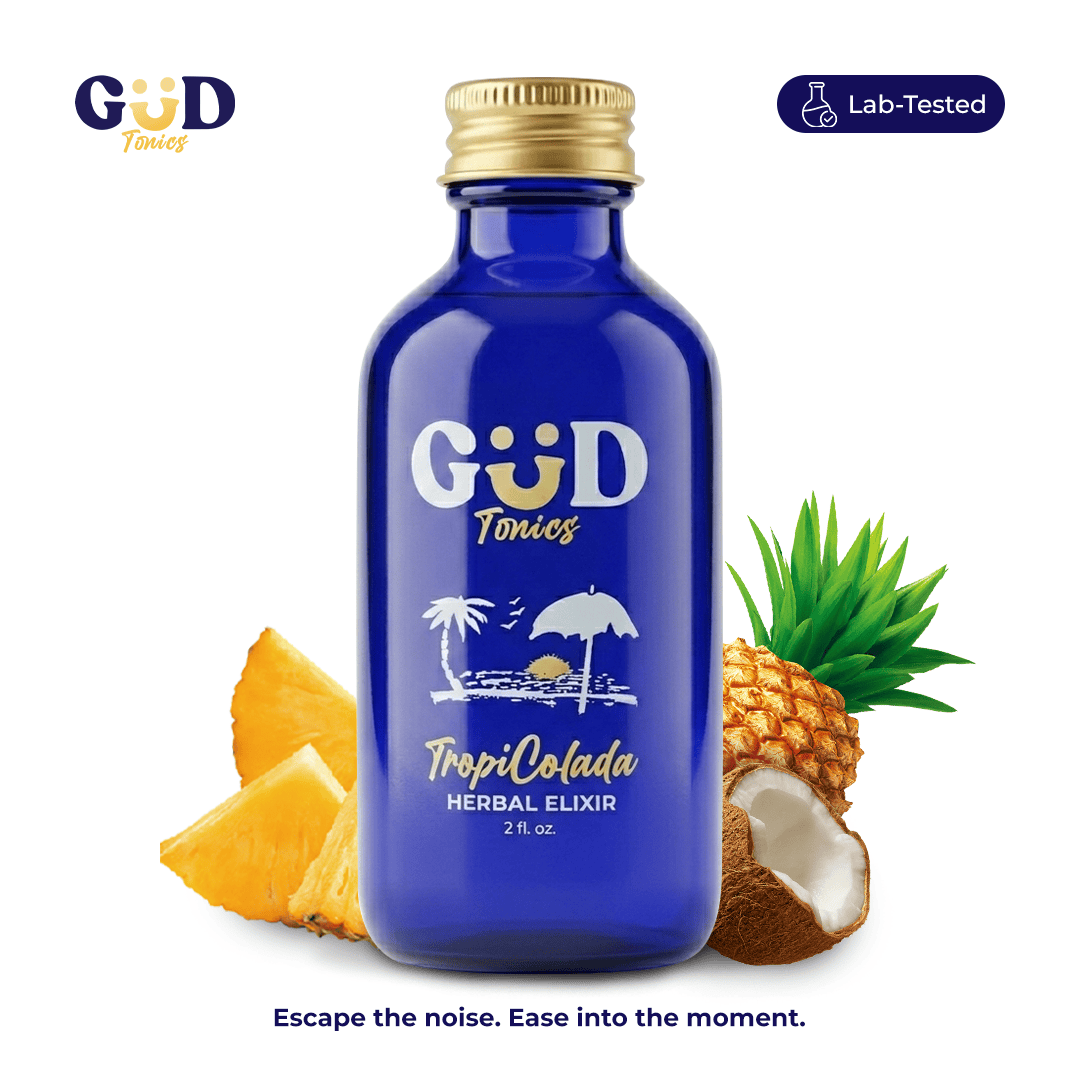
GUD Tonics sells three ready-to-drink flavors, Baja Bliss, Pink Sunset and TropiColada, a bundle of them, and a raw kava extract powder. Every drink lists kratom. Pink Sunset's product page lists: "Water, Glycerin, Noble Kava Root Extract, Sunflower Lecithin, Natural Flavors, Stevia, Mitragyna Speciosa, Potassium Sorbate (Preservative), Piperine Extract". Baja Bliss's page spells the plant "Mitregyna Speciosa" (sic).
No product description or ingredient list states an amount of kratom, mitragynine or kavalactones. Our FAQ says mitragynine is "in every ready-to-drink GUD Tonic, which is why our drinks are for adults 21 and over only." The figures are on the certificates on our lab results page: one per drink, all for lot 082026, from Cora Science, LLC, reported August 6, 2026. Per bottle, they show:
| Result, lot 082026 | Baja Bliss | Pink Sunset | TropiColada |
|---|---|---|---|
| Mitragynine | 88.5 mg | 87.7 mg | 87.4 mg |
| The minor alkaloid (printed as "7-Hydroxymitragynine") | <LOQ | <LOQ | <LOQ |
| Alkaloid limit of quantitation | 1.28 mg | 1.29 mg | 1.28 mg |
| Total kavalactones | 464 mg | 546 mg | 559 mg |
| MGPI, MGM-15, MGM-16, heavy metals, microbes, pesticides, residual solvents | Not reported | Not reported | Not reported |
Each result's specification column reads "Report Results", so there is no pass or fail limit. "<LOQ" means below the limit of quantitation, here 1.28 to 1.29 mg per bottle; it is not zero. No alkaloid result is printed per milliliter. These are measurements of one sample from one lot, not a serving, a dose or a safe amount, and the lab says its results "relate only to the specific sample of material or product analyzed." The powder's certificate covers kavalactones only.
Would our drinks meet DEA's proposed test? This article does not say. That is a question for a laboratory and for counsel.
Our own arithmetic, labeled as ours. If the minor alkaloid sat just under the quantitation limit, mitragynine divided by that limit would be about 68 to 69 (87.4 / 1.28, 87.7 / 1.29 and 88.5 / 1.28), below 100. The real amount could be lower, but the certificates cannot show it, and they report no MGPI. Converting the limit with the lab's measured density gives roughly 0.022 mg per milliliter for the minor alkaloid alone, with MGPI unknown. And a limit of 1.28 mg per bottle cannot show that a bottle is under Mississippi's 0.5 mg per container.
Some of our copy goes further than our certificates. Our product pages say "third-party lab-tested every batch", yet one lot per drink is posted, and "No synthetics, ever.", yet no certificate tests for MGM-15 or MGM-16. Our FAQ calls the drinks a "supplement"; FDA says kratom "is not lawfully marketed as a dietary supplement". Two product pages say "start with half" and the bundle page says "Stock up". This article gives neither kind of advice.
What we plan to do: ask our lab for a panel that reports MGPI, MGM-15 and MGM-16, with a lower quantitation limit for the minor alkaloid, and post it. Check our printed labels against New York's law before December 19, 2026. Review our product-page and FAQ copy. And redirect our July 23, 2026 drinks article, written before the October notices, to this page.
How to read a kratom drink label and certificate after the proposal
Whether or not an order publishes, the label and the certificate are the two documents you can check yourself.

Find the plant, not the front panel. A kava tonic or a botanical shot can contain kratom, not just a kratom soda. Look for Mitragyna speciosa in the ingredients, allowing for misspellings like ours, or for other names FDA's import alert treats as kratom, among them biak-biak, ketum and thang.
Amounts may be missing. The Public Health Reports commentary describes "limited or confusing information about the quantity of kratom in their drinks, sometimes omitting that kratom is in their product at all." From December 19, 2026, New York's label law requires declared amounts of mitragynine and the minor alkaloid, plus warnings that kratom "may be addictive" and "may interact with certain medications, drugs, and controlled substances".
A certificate answers only the questions it was asked.
| Question | What would answer it | What cannot |
|---|---|---|
| Is kratom in the drink? | Mitragyna speciosa in the ingredients, or a mitragynine result. | The word "kava" on the front. |
| Is MGPI, MGM-15 or MGM-16 in it? | A result line for each, with the lab's limit. | A certificate that does not list them. |
| Is it over 1 mg per milliliter? | The minor alkaloid and MGPI, stated per milliliter. | Per-bottle figures alone. |
| Is the mitragynine ratio below 100? | Measured amounts of all three. | "<LOQ" with a limit too high to settle it. |
| Is it safe? | Nothing on a certificate. | Any number, below the line or not. |
Two rules cover most of it: a certificate shows nothing about a compound it did not test, and "<LOQ" is not zero. Ask us about anything on ours through our contact page. For which drinks on the market carry kratom, see our guide to spotting kratom in drinks. And because our drinks contain kava and kratom, read our article on driving after kava before you get behind the wheel after one. The short version is do not.
Questions people ask about kratom drinks
Does DEA's proposal ban kratom drinks?
Not as a category. DEA's October 14, 2026 notice would control the concentrated minor alkaloid and MGPI above 1 milligram per milliliter in a liquid, or when mitragynine divided by them is less than 100, and binds no one until DEA publishes an order, which it said would come no earlier than November 13, 2026. Separately, MGPI, MGM-15 and MGM-16 were temporarily placed in Schedule I in any amount on August 26, 2026. Some states bar or ban kratom drinks.
What does 1 milligram per milliliter measure?
A concentration: milligrams of the minor alkaloid and MGPI, alone or combined, per milliliter of the liquid. The notice does not define "liquid preparations" and never says per bottle or per serving. It is a test for products, not an amount for anyone to drink.
Is a kratom drink below the proposed line safe?
DEA and HHS have not said so. DEA's notice states that "neither HHS nor DEA has made a finding that these substances are safe to use at below-threshold levels." FDA warns consumers not to use kratom, citing risks that include liver toxicity, seizures and substance use disorder.
Can a certificate of analysis show whether a drink meets the proposed test?
Only if it reports measured amounts of mitragynine, the minor alkaloid and MGPI that can be stated per milliliter. A result below the limit of quantitation is not zero, and an untested compound is unknown. Ours report mitragynine, give the minor alkaloid only as below that limit, and do not report MGPI, MGM-15 or MGM-16.
Do GUD Tonics drinks contain kratom?
Yes. Every ready-to-drink GUD Tonic lists Mitragyna speciosa (kratom) and noble kava root extract, and our drinks are for adults 21 and over only. Our certificates for lot 082026 report 87.4 to 88.5 mg of mitragynine per bottle: a lab measurement of one lot, not a serving, a dose or a safe amount.
Disclaimer: this article summarizes public documents and our own store pages as of November 5, 2026. It is general information, not legal or medical advice. State laws differ and change, and no figure on this page is a serving, a dose or a safe amount. Statements about botanical products have not been evaluated by the Food and Drug Administration, and no product is intended to diagnose, treat, cure or prevent any disease.