Listen to this page
Read by an AI voice. The full article is read aloud, top to bottom, including the help lines. The comparison table and the two images are on the page.
Help first. If someone is difficult to wake, is not breathing normally, is having a seizure, or is unresponsive, call 911.
Anywhere in the United States: Poison Control on 1-800-222-1222, around the clock, for a reaction that worries you after any kava or kratom drink, ours included. The 988 crisis lifeline, by call or text. The federal treatment locator is findtreatment.gov.
Kratom is not a treatment for opioid use disorder, or for opioid or kratom withdrawal, and neither is any kratom drink, ours included. Buprenorphine, methadone and naltrexone are the medicines with the evidence base for opioid use disorder, prescribed by a clinician. Clinical questions belong with a clinician who can see you. Not with us.
What drinks have kratom in them? A specific set of formats. Kratom turns up in small "shots" sold like energy shots, in kava tonics blended with kratom, in other ready-to-drink kratom beverages, seltzers among them, and in some teas and drinks served at bars, tea houses and cafes. Ohio's Bureau of Criminal Investigation, two CDC reports, FDA warning letters, a New York court and a study of 107 ready-to-drink kratom products all describe drinks like these. Check the label, though researchers say some drinks leave kratom off it. Look for Mitragyna speciosa, kratom, kratom leaf extract or mitragynine, which some sellers shorten to "MIT".
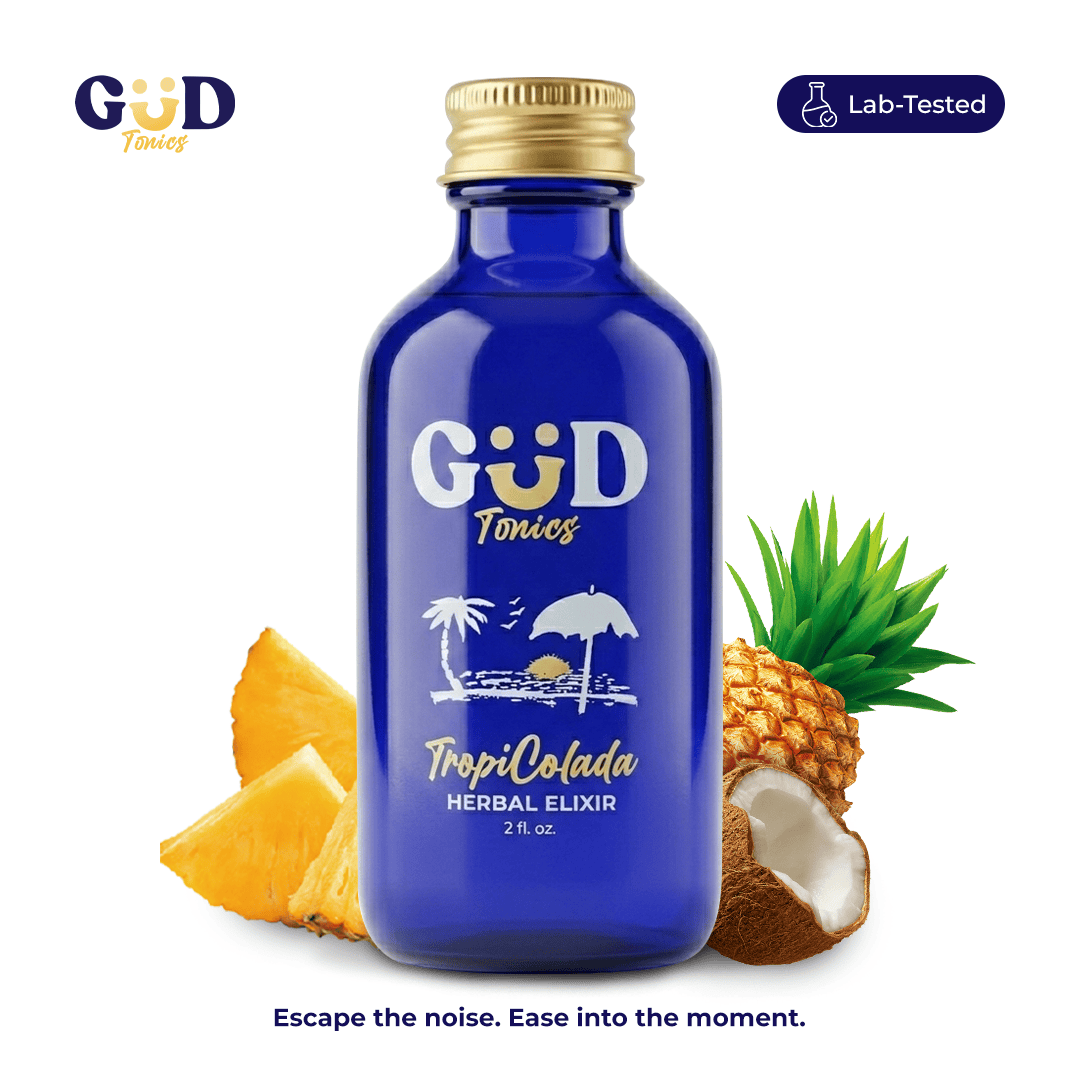
Our own drinks are on that list. Every ready-to-drink GUD Tonic lists Mitragyna speciosa (kratom) as well as noble kava root extract. So if you came here to find out whether a kava drink can contain kratom: ours do.
None of the agency or study texts we read says that mainstream canned energy drinks contain kratom. The one we checked, C4 Performance Energy, lists no kratom on the two flavor panels we read. We make no claim about any other brand.
Our advice: turn the can or bottle around and read the ingredient list. A front that says kava, tonic, botanical or energy tells you nothing about kratom.
Checked October 26, 2026. This page covers which drinks carry kratom, how to spot it on a label, what agencies and researchers say, state limits, and our own drinks.
Who wrote it. GUD Tonics, which sells kava drinks that also contain kratom (mitragynine), and a kava extract powder. All three of our ready-to-drink flavors, and the bundle of all three, list Mitragyna speciosa as well as noble kava root extract. We have an interest in how you read this page.
Federal status as of October 26, 2026. Kratom leaf and mitragynine are not federally scheduled. MGPI, MGM-15 and MGM-16 have been temporarily in Schedule I since August 26, 2026. On October 14, 2026, DEA published a notice of intent (FR Doc 2026-20943, 91 FR 65370) proposing temporary Schedule I for the concentrated minor alkaloid and MGPI above a threshold, and said the temporary scheduling order will be published "on or after November 13, 2026". No temporary order had been published as of October 26, 2026.
Next review January 26, 2027, or the day any source above changes.
The drink formats that carry kratom
Small shots sold like energy shots. The Ohio Attorney General's Bureau of Criminal Investigation, in a June 2026 kratom field guide for officers, lists among retail packaging indicators "Liquid shots packaged like energy shots (1- to 3-ounce bottles)". A CDC report of March 26, 2026, describes kratom's shift to "a rapidly expanding commercial market of powders, tablets, gummies, and concentrated energy shots". And in a commentary in Public Health Reports, published online on January 12, 2026, Perry and Chin focus on "kratom drinks that are sold as prepackaged beverages, typically in a shot or small volume size, and that are highly concentrated".
Kava drinks with kratom added. Our drinks belong here. CDC's report of April 2, 2026, on kava and poison centers says commercial kava products "are commonly marketed as healthy alternatives to alcohol, sold near college campuses, and increasingly being combined with kratom, a psychoactive botanical with opioid-like effects, raising safety concerns". FDA's 2023 warning letter to Shot of Joy LLC covered a "Classic - Kratom & Kava Shot", among other products.
Other ready-to-drink kratom beverages, seltzers among them. A study published online on November 30, 2025, examined "the front labels and websites of 107 ready-to-drink kratom products". Kratom seltzers are sold too, but the only government text we found that names them is Florida's HB 1205 of 2026, which would have defined a "kratom beverage" to include "a tea, seltzer or tonic water, or tincture". It died in committee on March 13, 2026.
Teas and drinks at bars and cafes. Nemours, a pediatric health system, wrote in September 2025 that Feel Free drinks, whose CLASSIC version "contains kava root and leaf kratom", "can also be found in bars and tea houses". In New York City, a trial court in March 2025 turned down the challenge of a cafe that "sold Kava and Kratom (herbal extracts) in tea form" after the health department refused to renew its permit. One decision, under the city Health Code; we do not know if it was appealed.
Drink mixes. In a June 2025 warning letter about a drink mix with kratom extract added, FDA wrote: "There is no food additive regulation that authorizes the use of kratom extract in food".
Kava on its own is not kratom. NCCIH lists kava as Piper methysticum, "a member of the pepper family"; FDA calls kratom "a tropical tree (Mitragyna speciosa) that is native to Southeast Asia". A kava drink that also lists Mitragyna speciosa is both, never "just kava". Ours are both.
Is kratom in energy drinks?
The agency texts we read describe kratom shots packaged or sold like energy shots. They do not say mainstream energy drinks contain kratom.
The clearest example is an allegation in a lawsuit. On September 23, 2026, Arizona's Attorney General sued Botanic Tonics, LLC under the Arizona Consumer Fraud Act. The Attorney General's press release says the alleged violations include "unlawfully promoting the 2-ounce kratom shots as energy drinks, obscuring feel free's kratom content, and failing to adequately disclose the risks of addiction and withdrawal from using the product". These are allegations, not court findings. We read the release, not the complaint.
Does C4 have kratom? The two C4 Performance Energy flavor panels we read on cellucor.com on October 26, 2026, list caffeine, beta-alanine, betaine and other ingredients, and no kratom or Mitragyna speciosa. We checked no other C4 line, flavor or brand.
One more honest point. Our drinks come in 2 fl oz bottles, our site footer calls them "Shots", and our product pages offer a subscription. That is the same bottle size, and one of the sales practices (recurring subscriptions), named in Arizona's allegations against another company. We draw no legal conclusion about ourselves; we tell you so you can weigh our words.
Kratom drinks at a glance
| Drink format | Where kratom appears | How to tell on the label | Source |
|---|---|---|---|
| Shots sold like energy shots. | Liquid shots in 1- to 3-ounce bottles. | Mitragyna speciosa, kratom, kratom extract or mitragynine in the ingredients. | Ohio BCI field guide, June 2026; CDC, March 2026. |
| Kava tonics and shots with kratom. | Kava drinks combined with kratom. | The front may say kava. Look for Mitragyna speciosa. | CDC, April 2026; FDA warning letter, 2023; our product pages. |
| Other ready-to-drink kratom beverages, including seltzers. | 107 products studied from labels and websites. | Content given as extract, alkaloids or mitragynine, in mixed terms. | Perry and Chin; Florida HB 1205 (died). |
| Teas and drinks at bars and cafes. | Kava and kratom served in tea form. | A served drink may have no label. Ask what is in it. | New York trial court, 2025; Nemours blog, 2025. |
| Drink mixes. | Kratom extract added to the mix. | Kratom extract in the ingredients. | FDA warning letter, June 2025. |
| Mainstream canned energy drinks. | Not named as containing kratom in any agency or study text we read. | Read the panel. The two C4 Performance Energy panels we read list none. | C4 label images, read October 26, 2026. |
How kratom shows up on a label
Kratom goes by many names. FDA's Import Alert 54-15, published August 17, 2026, lists the ones it treats as kratom, among them "mitragynine extract", "ketum", "Maeng da leaf" and "thang".
On a drink, look for the botanical name first, Mitragyna speciosa. Then the word kratom, alone or as kratom leaf or kratom extract, which is FDA's term in its drink-mix letter. Then mitragynine, a compound in the kratom leaf.
"MIT" is industry shorthand for mitragynine. Our own FAQ uses it. None of the agency or statute texts we read does.
Even our site uses three names for one ingredient: "Mitragyna Speciosa" in the ingredient lists (misspelled "Mitregyna Speciosa" on Baja Bliss), "Kratom (Mitragyna Speciosa) Extract" in the product photos, and "Kava Kratom Extract" in the product titles.

Amounts are harder. Perry and Chin's study of 107 ready-to-drink kratom products found, from labels and websites, that "Kratom content ranged from 20 mg to 500 mg per drink", stated in "inconsistent terms such as 'extract,' 'alkaloids,' or 'mitragynine'". That is one study's reading of printed claims: not a lab result, not a serving guide, and not figures you can compare, since an extract weight and a mitragynine weight measure different things. In their commentary, the same authors write that kratom drinks often have "limited or confusing information about the quantity of kratom in their drinks, sometimes omitting that kratom is in their product at all".
What some states require. South Carolina's Act 35 of 2025, in force since July 11, 2025, covers kratom in a "drink" and lists eight items a label must carry. They include "a list of the ingredients used in the manufacture of the product", the amount of mitragynine and of a minor kratom alkaloid, and "a statement that the sale or transfer of the product to a person under twenty-one years of age is prohibited". Rhode Island's Department of Health lists required statements that kratom "may be habit forming" and "is not safe for use while pregnant or breastfeeding", plus a warning about "dangerous medication interactions".
Our advice: treat a label as a claim, and look for a certificate from an outside lab behind it. Ours are on our lab results page; check what each one tests and what it leaves out.
What the research and poison centers say
Poison centers. CDC's April 2026 review covered kava exposures reported to US poison centers from 2000 to 2025. Kava reports reached 203 in 2025. CDC says "reports involving combined use of kava and kratom have increased, reaching 30% (61) of all kava reports in 2025". It adds that the increases "have coincided with higher rates of serious reported clinical outcomes in recent years (32% in 2025 compared with 12% in 2000)". In exposures involving only kava and kratom, "neurologic effects included seizures and tremor, and cardiovascular effects included hypertension".
CDC names the limits itself: reporting is voluntary, so mild cases are likely missed, and "NPDS generic codes do not permit distinction among product types", so CDC could not say how many involved a drink. These are counts of reports, not a rate of harm among people who drink these products.
The researchers. Perry and Chin's Public Health Reports paper is a commentary, not a study of drinkers, and its authors report no funding and no conflicts.
The only controlled trial of a kava-and-kratom drink we found was contracted by the drink's maker, Botanic Tonics, and ran for six consecutive days in healthy adults (Cureus, December 2024). We do not cite it as evidence that these drinks are safe.
The national survey. The University of Michigan's news office headlined its May 14, 2026, release "Not just an energy drink", but the study behind it covers kratom use of any kind, not drinks. The release says the share of Americans 12 and older who had ever used kratom rose from 1.6% in 2021 to 1.9% in 2024. The study links kratom use with substance use disorder and mental health, but the survey "cannot determine which came first". Association, not cause.
FDA's own warning. "FDA has warned consumers not to use kratom because of the risk of serious adverse events, including liver toxicity, seizures, and substance use disorder (SUD)".

Where kratom drinks are restricted
Start with the federal position. FDA's kratom page says "kratom is not lawfully marketed as a dietary supplement and cannot be lawfully added to conventional foods". That is a regulatory determination FDA enforces case by case, through warning letters and import alerts, not a criminal ban or a scheduling order. FDA adds that "states may have their own regulations or prohibitions for kratom products". The states we read, with the status of each:
Rhode Island: in force since April 1, 2026. The Department of Health's kratom licensing page, updated on October 20, 2026, bars "A kratom product that is a conventional food or beverage or labeled as a conventional food or beverage product". It also bars any kratom product containing "a substance other than a non-psychoactive substance necessary for the preparation, processing, or manufacturing of said product". Sales are limited to a licensed retailer's fixed location, delivery to buyers is prohibited, and the age is 21.
Ohio: layered agency positions. The Department of Agriculture's February 2026 fact sheet says natural kratom "is not permitted to be processed into, or marketed as, a food, drug, or dietary supplement". The Attorney General's June 2026 field guide lists "liquids, and drinks" among prohibited forms. A Board of Pharmacy emergency rule from December 12, 2025 "does not apply to isolated mitragynine", and we could not confirm its status after its 180 days. Ohio does not reduce to one line.
Utah: current text in force since May 6, 2026. Utah's rule on what processors and retailers may sell turns on two tests: whether a product is "pure leaf kratom", which Utah defines to exclude kratom extract and mixtures with nonkratom substances, and whether its label states the amount of mitragynine and of a minor kratom alkaloid. How those tests read together is a question for a lawyer, and we draw no conclusion. The age is 21.
South Carolina: in force since July 11, 2025. South Carolina regulates rather than bans. Kratom in a drink is covered, the label list above applies, and sale under 21 is prohibited.
Minnesota: age 21 since August 1, 2026. Laws 2026, chapter 63, signed on May 5, 2026, raised the age from 18 to 21 in Minnesota's criminal law on selling or possessing "kratom or a substance that contains mitragynine". It names mitragynine, not just kratom: one more reason to read the ingredient list.
Outright bans. Tennessee's kratom ban "took effect on July 1, 2026", according to Metro Nashville's beer permit board. Louisiana's Office of Alcohol and Tobacco Control says "the possession and distribution of Kratom are now illegal", with fines for sellers from August 1, 2025. Massachusetts' Department of Public Health designated kratom a Schedule I substance under state law by emergency order, from August 28, 2026, for up to a year.
This part cuts against us. As of October 26, 2026, the no-ship lists on our product pages and in our site footer leave out Tennessee, Ohio, Utah and Louisiana as a whole (they name three Louisiana parishes), and the product-page list also leaves out Massachusetts, which the footer list names. Our Shipping Policy says we ship "to all US states where Kratom is legal". That is a gap between our own policy and the bans above. Do not read our checkout as a legal check.
Our advice: check your own state's rule before you buy any kratom drink, ours included. A store that ships to your address, or a shelf that stocks the drink, is not proof that it is legal where you live.
Our drinks: what is in them and what our pages show
We sell three ready-to-drink flavors, Baja Bliss, Pink Sunset and TropiColada, plus a bundle of all three. Our FAQ says each one "is made with noble kava root extract and Mitragyna speciosa (kratom), lightly sweetened with stevia". It also says mitragynine is "in every ready-to-drink GUD Tonic, which is why our drinks are for adults 21 and over only". Our home page FAQ is vaguer ("others may vary by product"), but as of October 26, 2026, every drink we sell lists kratom.
The certificate for each flavor, on our lab results page, reports kratom alkaloids alongside kavalactones, with no heavy-metal, microbial, pesticide or solvent panel. Our kava extract powder is different. It lists no kratom, and its certificate tests kavalactones only, but its page carries a "Kava + Kratom" block, so we do not call it kratom-free.
As of October 26, 2026, our certificates for lot 082026 report about 87 to 89 mg of mitragynine per bottle, depending on the flavor, while our product pages state no amount at all. That figure is a lab measurement of one lot, not a serving and not a dose. The pages carry a driving warning ("Don't drive or operate machinery after drinking"), but no pregnancy or breastfeeding warning, no statement that kratom may be habit forming, and no medication-interaction warning, the kinds of statement Rhode Island requires on a kratom label. We have not checked the printed back label.
Our advice: treat any of our drinks as kava plus kratom, never as "just kava". Do not drive after one, for the reasons in our article on driving after kava. Our product pages say never mix with alcohol, and NCCIH says "Kava should not be used together with other substances that have sedative effects, such as benzodiazepines or alcohol". We cover alcohol and medicines in our article on kava and kratom interactions.
Questions about what is in a bottle: ask us through our contact page. Questions about your health or medicines: a clinician or pharmacist, not us.
Our advice before you open a can or bottle
- Read the ingredient list, not the front. Kratom can appear as Mitragyna speciosa, kratom, kratom leaf, kratom extract, mitragynine or "MIT", or behind a strain word like Maeng Da.
- No ingredient list, or one you cannot read? Do not drink it.
- If a number is printed, note what it measures and what it covers. It is a label claim, not a recommendation.
- Under 21? Several states set 21, and our drinks are for adults 21 and over only.
- Pregnant or breastfeeding? Do not drink one. FDA warns consumers not to use kratom, and NCCIH says kava "may have special risks if taken during pregnancy or while breastfeeding".
- No alcohol or sedatives with it, no driving after it, and ask a pharmacist or clinician about any medicine you take.
- Keep any kratom drink out of reach of children.
- A reaction that worries you: call Poison Control on 1-800-222-1222, and report it to FDA's MedWatch program or Safety Reporting Portal.
Questions people ask about kratom drinks
What drinks have kratom in them?
Shots sold like energy shots, kava tonics blended with kratom, other ready-to-drink kratom beverages including some seltzers, and some teas and drinks at bars and cafes. Check the ingredient list. Every ready-to-drink GUD Tonic contains kratom as well as kava.
Is kratom in energy drinks?
None of the agency or study texts we read says mainstream canned energy drinks contain kratom. They describe kratom shots sold like energy shots. Arizona's Attorney General alleges that one company promoted 2-ounce kratom shots as energy drinks; those are allegations, not findings.
Does C4 energy drink have kratom?
C4's own ingredient panel for C4 Performance Energy, in the two flavors we checked on cellucor.com on October 26, 2026, lists caffeine, beta-alanine, betaine and other ingredients, and no kratom or Mitragyna speciosa. We did not check other C4 lines or flavors, or any other brand.
How can you tell if a drink has kratom in it?
Read the ingredient list, not the front. Look for Mitragyna speciosa, kratom, kratom extract or mitragynine, sometimes shortened to MIT. A drink sold as kava can still contain kratom. Our advice: no ingredient list, no drink.
Do GUD Tonics drinks contain kratom?
Yes. Every ready-to-drink GUD Tonic lists Mitragyna speciosa (kratom) as well as noble kava root extract. Our drinks are for adults 21 and over only.
Disclaimer: this article summarizes publicly available material and our own store pages as of October 26, 2026. It is general information, not legal or medical advice. State laws differ and change, and no figure on this page is a serving, a dose or a safe amount. Statements about botanical products have not been evaluated by the Food and Drug Administration, and no product is intended to diagnose, treat, cure or prevent any disease.