
Listen to this page
Read by an AI voice. The full article is read aloud, top to bottom, including the help lines. The two tables and the two images are on the page.
Help first, in case the mixing has already happened. If someone is difficult to wake, is not breathing normally, is having a seizure, or is unresponsive, call 911.
Anywhere in the United States: Poison Control on 1-800-222-1222 if a drink like ours has already been taken with a medicine, alcohol or anything else, or for any question about a product. Say it contains kava and kratom, and what else was taken. The 988 crisis lifeline, by call or text. The federal treatment locator is findtreatment.gov.
Kratom is not a treatment for opioid use disorder, or for opioid or kratom withdrawal, and neither is any kava drink, ours included. Opioid use disorder is treated with medicines such as buprenorphine, methadone and naltrexone, prescribed by a clinician. Every clinical question this article raises belongs with a clinician who can actually see you. Not with us.
Among kratom interactions and kratom drug interactions, what kratom does to other medicines has been tested in a controlled human trial exactly once. The short answer, from the agencies: do not combine kava with alcohol or with sedatives such as benzodiazepines, and if you take any medicine, talk with your health care provider first. Poison Control is on 1-800-222-1222.
Every drink we sell contains both kava and kratom, so this page covers both plants: each pair people search for, at the level of evidence it actually has, and then our own bottles, by certificate.
Checked 6 October 2026. This page covers kratom and kava with alcohol, sedatives, opioids, antidepressants, stimulants and gabapentin, and the two plants together. Main sources: CDC poison center reports of March and April 2026, a 2023 clinical trial, NCCIH, DEA and FDA, and our lot certificates of 6 August 2026.
Who wrote it. GUD Tonics. We sell kava and kratom drinks, so we have an interest here, and this page carries no product links.
Next review 6 January 2027, or the day any source above changes.
The short version, as the agencies word it
The clearest do-not-mix instruction we found from a US health agency is about kava, not kratom:
Kava should not be used together with other substances that have sedative effects, such as benzodiazepines or alcohol. If you take any type of medicine, talk with your health care provider before using kava or other herbal products; some herbs and medicines interact in harmful ways.
That is NCCIH, the National Center for Complementary and Integrative Health, on its kava page, updated in April 2025. The DEA's kava fact sheet, dated April 2026, puts it more plainly still: "Said another way, using kava with other drugs or alcohol may increase the risk for harmful effects."
We found no rule that tidy for kratom. NCCIH's kratom page says that combining kratom with other drugs "has been linked to deaths and severe adverse effects such as liver problems. More research is needed on drug interactions involving kratom." FDA's kratom page has no sentence using the words "drug interaction", but it does say "FDA has warned consumers not to use kratom". Our own product pages say two things on the subject: adults 21 and over, and "never mix with alcohol."
Kratom interactions at a glance: the evidence for each pair
Read the second column first. It is mostly empty.
| Combination | Controlled human study | Other human evidence | CDC poison center data |
|---|---|---|---|
| Kratom + alcohol | None | None found | 22% of multi-substance reports; 19% of deaths |
| Kratom + benzodiazepines | Midazolam probe only; blood levels, not sedation | None specific | 15% of multi-substance reports; 20% of deaths |
| Kratom + opioids | None | Nine Swedish deaths with a tramadol metabolite and other drugs | 16% of multi-substance reports; 62% of deaths |
| Kratom + SSRIs, SNRIs | No CYP2D6 effect at one low dose | A few single-patient serotonin syndrome reports | Antidepressants: 14% of multi-substance reports |
| Kratom + stimulants | None | None specific to amphetamine or caffeine | 11% of multi-substance reports; 20% of deaths |
| Kratom + gabapentin | None | One death, with a kava compound and other drugs | Not listed |
| Kava + alcohol or benzodiazepines | None | One 1996 coma case with alprazolam | Most common kava co-substances, annual averages 7% and 5% |
| Kava + kratom | None | One death in a conference abstract, with other drugs | 30% (61) of all kava reports in 2025 |
The kratom figures come from CDC's March 2026 poison center report. They are shares of the 5,513 reports, out of 14,449 kratom reports from 2015 to 2025, that involved more than one substance, or of 233 kratom-associated deaths, and not shares of people who use kratom. CDC also says that with several substances reported, "determining which substance was most related to clinical effects or medical outcome, including death, was not possible." A co-exposure is a reason to look closer, not proof of an interaction.
How kratom drug interactions work, in plain words
One substance can change another in two ways. The first is about levels: the body clears most medicines with a family of enzymes called cytochrome P450, or CYP, and if something slows them down, more of a medicine stays in the blood than the prescriber planned for. The second is about effects, where two things that each slow the brain add together. CDC's March report names both, saying kratom used with alcohol, opioids, benzodiazepines, stimulants or antidepressants "might increase risk through additive pharmacodynamic effects on central nervous system pathways and through pharmacokinetic interactions that increase systemic exposure to substances used with kratom."
Three names matter. CYP3A and CYP2D6 are two of those enzymes. P-gp, short for P-glycoprotein, is a transporter that pumps certain drugs out of cells. A 2023 review by the team behind the trial below concluded that "The in vitro evidence and clinical case reports to date point to CYP3A, CYP2D6, and P-gp as targets of potential clinical pharmacokinetic kratom-drug interactions." In vitro means laboratory preparations, not people. In them, the kratom alkaloid mitragynine blocked CYP2D6 most strongly of all. The human trial found something different.
The one trial of kratom's effect on other drugs
In 2023, a trial run at Washington State University, funded by the National Institutes of Health and published in Clinical Pharmacology & Therapeutics, became, in its authors' words, "the first to clinically evaluate the pharmacokinetic drug interaction potential of kratom." The full paper is free on PubMed Central.
Twelve healthy adults who had used kratom before, six men and six women, took two probe drugs on two occasions at least a week apart: once alone, and once 15 minutes after a kratom tea made from 2 g of one powder, about 39 mg of mitragynine, a single dose the authors call low. Midazolam, 2.5 mg, tracks CYP3A. Dextromethorphan, 30 mg, tracks CYP2D6.
Kratom had no effect on dextromethorphan's total exposure or peak level, with ratios of 0.99 (90% confidence interval 0.83 to 1.19) and 0.96 (0.78 to 1.19), where 1.00 means no change, though dextromethorphan's absorption looked slower. Midazolam rose. Its total exposure went up by a ratio of 1.39 (1.23 to 1.57) and its peak by 1.50 (1.32 to 1.70), roughly 40% and 50% more, and exposure rose in all but one participant. Its half-life ratio was 1.07, essentially unchanged, so the authors think kratom mainly blocked CYP3A in the gut, much like the grapefruit juice and felodipine interaction they compare it to. Their conclusion: "Co-consuming kratom with certain drugs extensively metabolized by CYP3A may precipitate serious interactions."
The authors list the limits themselves. One dose, once. In the lab, mitragynine is a "time-dependent" CYP3A inhibitor and also a weak inducer, so daily use could act more strongly, or differently. The midazolam dose was below a therapeutic one, so the trial measured blood levels, not whether anyone got sleepier. One product, by mouth, in 12 healthy volunteers. At higher doses and with chronic use, they add, effects on liver CYP3A and CYP2D6 could follow, "widening the range" of drugs affected.
One limit is ours to add. Our certificates report 87.4 to 88.5 mg of mitragynine per bottle, one sample per drink, more than twice the trial dose. The trial used leaf tea, not a drink that also contains kava. It does not describe what a bottle of ours, or half of one, does to anything, and we found no study that does. None of this is a guide to how much to drink.
Interactions run the other way too. In a 2024 study, four days of itraconazole, a drug that blocks CYP3A4, raised volunteers' peak mitragynine level about 1.5-fold.
Kratom drug interactions, pair by pair
Kratom and alcohol
We found no controlled human study of kratom and alcohol. The poison center record does show it, though: ethanol was the most common co-substance in multiple-substance kratom reports, and it appeared in 19% of the deaths. For kava, FDA's 2020 memo says "Kava is often consumed with alcohol, which may potentiate the hepatic injury", hepatic meaning liver, and that "a synergistic effect is possible for substances acting on the central nervous system, such as alcohol, barbiturates and psychopharmacological agents."
Kratom and Xanax, and other benzodiazepines
The midazolam probe above is the only benzodiazepine given with kratom under controlled conditions, and sedation went unmeasured. We found no study of alprazolam (Xanax), clonazepam or diazepam with kratom. For kava, NCCIH names benzodiazepines outright. LiverTox, an NIH reference, summarizes a 1996 case in which a man "developed disorientation and coma 3 days after starting kava, while also taking alprazolam and cimetidine, drug-interactions perhaps explaining the serious neurological adverse event". One man, one case.
Kratom and opioids
There is no controlled human study of kratom with any opioid. A 2023 review describes nine deaths in Sweden linked to "krypton", kratom combined with a tramadol metabolite, each also involving two or more other drugs acting on the brain. In CDC's data, "Opioids were reported in 62% of fatalities". FDA's kratom page cautions that in the rare deaths associated with kratom, "kratom was usually used in combination with other drugs, and the contribution of kratom in the deaths is unclear." The same page says kratom's compounds may produce classic opioid-related effects, including sedation and respiratory depression: the kind of overlap behind the additive risk CDC describes.
Kratom, antidepressants and serotonin syndrome
The 2023 trial found no CYP2D6 effect, and its authors judged the risk at that dose "low for drugs eliminated predominately via CYP2D6-mediated metabolism (e.g., several selective serotonin reuptake inhibitors, beta blockers, and opioids)". That covers one low dose only, and the same authors warn that heavier or chronic use could widen the list. FDA adds that mitragynine also acts on "other chemical systems of the brain, including serotonin".
Then there are the case reports, each about one patient, none giving a rate. In 2022, a man on venlafaxine and quetiapine plus "a high amount of kratom (~90 g) daily" developed serotonin syndrome and ECG abnormalities, which resolved after the two drugs were stopped. In 2023, a 63-year-old man on five medicines, including bupropion and desvenlafaxine, plus kratom had "possible serotonin syndrome". A September 2026 case report describes a 38-year-old man on duloxetine, levomilnacipran, quetiapine and other drugs. Its authors write: "There are only 3 case reports connecting kratom to serotonin toxicity, and all are in the context of interactions with prescribed serotonergic agents." His product was tablets marketed as a single concentrated kratom alkaloid, not leaf kratom and not a drink.
Kratom and stimulants, including Adderall and caffeine
We found no controlled study and no case report specific to amphetamine (Adderall) or caffeine with kratom. CDC's stimulant class covers amphetamines, cocaine, methamphetamine, methylphenidate and several synthetic drugs; caffeine is not named. The 2023 review cites a presumed kratom and modafinil seizure case, and notes that drugs which lower the seizure threshold may raise the risk of kratom-related seizures. Seizures are on FDA's list of the serious risks it warns about with kratom.
Kratom and gabapentin
We found nothing controlled and no published case report of an interaction. There is one death, in a 2021 American Academy of Forensic Sciences conference abstract: a 56-year-old man whose blood held kavain, a kavalactone from kava, plus mitragynine, gabapentin and mirtazapine. The authors said the gabapentin and mirtazapine levels "appear benign", and that "the combination of kavain and mitragynine may potentiate lethal central nervous system toxicities." One case, an abstract rather than a peer-reviewed paper, the word "may", and other drugs present. It still involved compounds from both of the plants in our drinks.
Kava's own interaction record
In laboratory work, kavalactones inhibit a long list of CYP enzymes, and FDA's 2020 kava memorandum concludes that "kava has a high potential for causing drug interactions through inhibition of P450 enzymes responsible for the majority of the metabolism of pharmaceutical agents." In people, the measured effect has been narrower. A 2005 study gave 12 volunteers kava for 28 days and found "significant reductions (approximately 40%) in CYP2E1 only". LiverTox's reading of the human studies is that they suggest kava inhibits CYP2E1 alone, "and that its effects are modest."
On the effect side, the DEA says "High doses of kavalactones can also produce transient central nervous system depressant effects (e.g., sedation, muscle weakness)." Two more DEA lines are about businesses like ours. FDA concluded in 2020, the DEA notes, that "indiscriminate use of kava either as a 'recreational' or 'relaxation' beverage is not safe for human consumption", and "Some websites that promote and sell kava products also sell other psychoactive products, such as Salvia divinorum or kratom."
Kava and kratom interactions together: what CDC found
We found no pharmacokinetic or pharmacodynamic study of the two plants taken together. The nearest thing is a CDC report of 2 April 2026 on 3,101 kava-related poison center exposures from 2000 to 2025. Ethanol and benzodiazepines used to be the most common co-substances in kava reports, but "by 2019, kratom surpassed ethanol and benzodiazepines in multiple-substance kava-related exposures. This coincided with increasing availability of products containing kava and kratom". By 2025, reports involving both had reached "30% (61) of all kava reports".
The 128 exposures involving only kava and kratom "had similar symptomatology; however, neurologic effects included seizures and tremor, and cardiovascular effects included hypertension." Those are effects named among reports, not rates. Moderate liver enzyme rises were reported "in 29 of 1,754 (1.7%) single-substance exposures and eight of 128 (6.3%) multiple-substance exposures involving kava and kratom", and "no cases of acute liver failure were identified." Eight is a tiny number, not a risk multiple. Serious outcomes among all kava reports were 32% in 2025, against 12% in 2000, and there were eight deaths over the whole period, which the report does not attribute to kratom.
CDC also states its own limit: "NPDS generic codes do not permit distinction among product types." So the counts cannot show which reports, if any, involved ready-to-drink bottles, or ours.
What is in our drinks, by certificate
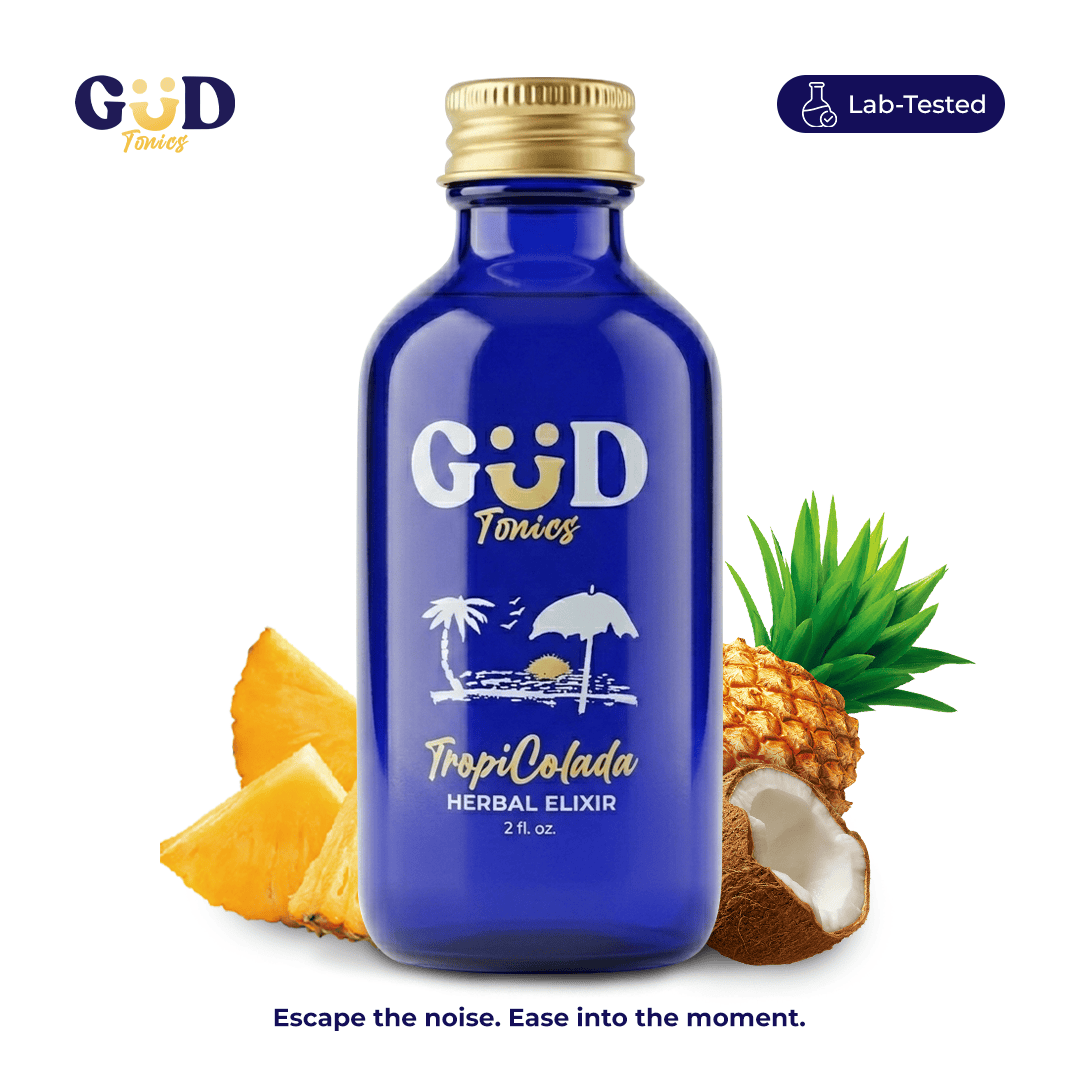
Each of our three drinks, Baja Bliss, Pink Sunset and TropiColada, lists Noble Kava Root Extract and Mitragyna speciosa, the kratom plant, among its ingredients, so everything above applies to every drink we sell. Our product pages do not state milligrams of mitragynine or kavalactones. The certificates on our lab results page do, per bottle, and our product pages list two servings per bottle. The per-serving column is our own division by two.
| Drink | Lot, lab, report date | Mitragynine per bottle | Total kavalactones per bottle | Per serving, our division |
|---|---|---|---|---|
| Baja Bliss | 082026; Cora Science, LLC; 6 Aug 2026 | 88.5 mg | 464 mg | 44.25 mg; 232 mg |
| Pink Sunset | 082026; Cora Science, LLC; 6 Aug 2026 | 87.7 mg | 546 mg | 43.85 mg; 273 mg |
| TropiColada | 082026; Cora Science, LLC; 6 Aug 2026 | 87.4 mg | 559 mg | 43.7 mg; 279.5 mg |
CDC describes the US market as products "advertised to contain >250 mg kavalactones per serving (30 ml), often with multiple servings per container." That sentence is about the market, not us, but our figures sit in the same territory: all three bottles hold more than 250 mg of kavalactones, and by our division two of the three are above it per serving. We are not going to call that "within limits". Our serving is half a bottle of a volume our pages do not state, so the 30 ml comparison is not exact. The 250 mg a day figure is an Australian rule for water-based kava extracts in medicines, cited in FDA's memo. It is not US law. None of these figures, ours or anyone's, is a guide to how much to drink.
Each certificate covers one sample of lot 082026, and the lab's own wording is that "the results relate only to the specific sample of material or product analyzed." Those results do not say how a bottle will interact with your medicines. Our guide on how to read a kratom certificate of analysis walks through the lines.
One more ingredient belongs on an interactions page: every one of our drinks lists Piperine Extract. Piperine is a major constituent of black pepper, and a 2002 laboratory study found that it inhibits P-gp and CYP3A4, two of the pathways above. That work used cells and human liver preparations, not people. The amount per bottle is not published on our pages, so we cannot tell you whether it changes drug levels in anyone. It is there, and it is one more reason to show your health care provider the whole ingredient list.

What the agencies say to do
Do not combine kava with alcohol or sedatives. That is NCCIH's advice, about kava, and every drink we sell contains kava. Benzodiazepines are its example.
If you take any medicine, talk with your health care provider first. NCCIH's general advice on supplements and medicines is to tell every provider about everything you take, so that "they can help you avoid harmful interactions". It also suggests bringing the bottles themselves to the appointment. FDA's consumer advice on the subject says "Natural does not always mean safe", and if you have surgery coming up, mention kava too: FDA's kava memo says it may "cause excessive perioperative sedation".

If something has already been mixed. Call Poison Control on 1-800-222-1222. For severe symptoms or immediate danger, NIDA's advice is to "seek immediate medical attention by calling 9-1-1 or visiting an Emergency Department."
Report a reaction. FDA encourages consumers to report adverse reactions to its MedWatch program or the Safety Reporting Portal.
A kava-kratom drink has two plants in it, and the do-not-mix advice written for either one applies to the bottle. For the dependence side of the same two plants, read our piece on whether kava is addictive. If we have a number wrong here, tell us and it gets corrected, with the date shown.
Questions people ask about kava and kratom interactions
Can you drink a kava-kratom drink with alcohol?
No. NCCIH says kava should not be used with sedatives such as benzodiazepines or alcohol, and FDA's 2020 kava memo says alcohol may potentiate kava's liver injury. Alcohol was also the most common co-substance in multiple-substance kratom reports to poison centers. Our product pages say never mix it with alcohol.
Is it safe to take kratom with Xanax or another benzodiazepine?
No study shows that it is. The only controlled data is a small probe dose of midazolam, a benzodiazepine, whose blood levels rose about 40% after kratom tea; sedation was not measured. We found no study of alprazolam, sold as Xanax, with kratom. NCCIH says not to combine kava with benzodiazepines. Talk with your health care provider first.
Can kratom cause serotonin syndrome with an SSRI or SNRI?
A few single-patient case reports describe serotonin syndrome in people taking kratom with serotonergic medicines, usually several at once. A 2023 trial found no CYP2D6 effect at a single low dose, which does not show the combination is fine. Case reports give no rate. Ask the health care provider who prescribes your medicine.
Has anyone studied kava and kratom taken together?
Not in a clinical study; we found none. CDC's April 2026 report found kava and kratom together in 30% of all kava poison center reports in 2025, and across 2000 to 2025, reports of the two alone named seizures, tremor and hypertension among their effects. Those are reports, not rates, and the data cannot identify product type or dose.
Disclaimer: this article summarizes publicly available material as of 6 October 2026 and links to primary sources so you can check them. It is general information, not medical advice, and no substitute for a clinician who knows your medicines. Poison center figures are reports, not counts of people harmed, and case reports describe single patients. Our laboratory figures come from one sample of one lot per drink. Statements about botanical products have not been evaluated by the Food and Drug Administration, and no product is intended to diagnose, treat, cure or prevent any disease.