Listen to this page
Read by an AI voice. The full article is read aloud, top to bottom, including the revision history. The product table is on the page.
Last revised 18 September 2026. This guide is dated on purpose. See How we revise this guide for what changed in this revision and why the date matters.
Before anything else, the ingredient you came here for may not be the only one in the bottle. Every GÜD Tonics ready-to-drink flavor contains two botanicals, not one: noble kava root extract and Mitragyna Speciosa, which is kratom. If you were searching for kava on its own, that is the thing to know before you buy rather than after. The one product in our line sold as a kava extract by itself is the Raw Kava Extract Powder, and if kratom content matters to you, read that product page and the label before you order.
These products are for adults 21 and over. They are not for anyone who is pregnant or breastfeeding. Talk with your healthcare provider before using kava, particularly if you have a liver condition or take any medication. Some states and counties are restricted at checkout, and each product page carries its own current list.
Table of contents
- The short version
- Why this page used to say something else
- What kava is
- What Mitragyna Speciosa is, and why it's in the bottle
- What is in a GÜD Tonics bottle
- What we stock, and what we don't
- Lab testing, and what we can show you today
- Safety and legality
- How we revise this guide
- Frequently asked questions
- The summary
The short version
- Kava is a root. Mitragyna Speciosa, or kratom, is a leaf. Our three ready-to-drink flavors contain both.
- The whole GÜD Tonics line is five items: three ready-to-drink flavors, a bundle of all three, and a raw kava extract powder. There is nothing else.
- Single bottles are $10.99, a 3-pack is $29.00, a box of 12 is $115.00, the bundle is $27.99, and the powder is $60.00 for 1oz or $160.00 for 3oz.
- All three flavors are alcohol-free and lightly sweetened with stevia. That is a product fact, and it is the only comparison to alcohol you will find on this page.
- We used to answer the kava versus alcohol question here. We took that out. Here is why.
- Adults 21 and over. Kava carries a documented liver risk that we cover in full below.
Why this page used to say something else
If you have been here before, this page looked different. It scored kava against alcohol across seven rounds and reached conclusions about what you would experience with each one. We removed every one of those conclusions.
Two reasons, and neither is a technicality.
The first is that we are not permitted to tell you what a botanical drink does to you, and we should not want to be. Claims about how a product makes you feel are drug claims. A beverage company that makes them is marketing an unapproved drug, whatever the intention behind the sentence.
The second is more specific to this page. Putting our product next to alcohol and declaring a winner is a claim about what our product replaces. We cannot support that claim with anything, and we would not stand behind it if we could. People stop drinking for reasons that have nothing to do with us, and a beverage company is the wrong source for advice about it.
So the honest answer to the question in this page's address is that we do not have one. What we can tell you is what is in the bottle, what the label says, what it costs, and what the published safety research says. That is the rest of this page.
We kept the web address rather than deleting the page. Breaking a link helps nobody, and we would rather you find the honest version at the address where you found the other one. We have taken the same position on a different question before, and wrote up our reasoning here.
What kava is
Kava is Piper methysticum. The National Center for Complementary and Integrative Health describes it plainly: "Kava is native to the South Pacific and is a member of the pepper family," and notes that Pacific Islanders have used kava beverages for thousands of years, in ceremonial settings. You will also see it called kava kava, awa, ava pepper or ava root.
The part used is the root, and traditionally it is prepared as a water-based beverage and shared. That preparation takes time and effort, which is most of why bottled and powdered formats exist at all.
Our ready-to-drink flavors and our powder both use noble kava root extract, which is the wording on our own product pages.
That is the whole botanical description. If you want to know what kava does, this page is not going to tell you, and you should be careful with any seller's page that does.
What Mitragyna Speciosa is, and why it's in the bottle
Mitragyna Speciosa is kratom, and NCCIH describes it as "a tree in the coffee family, found in Thailand and neighboring countries." The leaf is the part used. It is a different plant from kava, from a different part of the world, and it is regulated differently.
It also carries its own cautions, separate from kava's, and this page would be incomplete without them. NCCIH states that "kratom itself may have the potential to be addictive." Their page on kratom is worth reading before you buy anything containing it, ours included. Adults 21 and over.
Our three ready-to-drink flavors are formulated with both. That is a choice we made about the product, and it is why the bottles are labeled as kava kratom extract drinks rather than kava drinks. We say it at the top of this page and on every product page because a customer who finds out what kratom is after the purchase is a refund and a bad review, and because they deserved to know first.
The legal picture for kratom moves faster than the one for kava, and the two are not always treated the same way in the same state. We wrote about one case of that in what Minnesota's 21 rule actually covers.
What is in a GÜD Tonics bottle
Here is the whole line, side by side. Format, flavor, what botanicals are in it, and what it costs. Nothing in this table describes an experience.
| Product | Format | Flavor | Kava | Kratom | Price |
|---|---|---|---|---|---|
| Baja Bliss | Ready to drink bottle | Guava | Noble kava root extract | Yes, Mitragyna Speciosa | $10.99 single, $29.00 3-pack, $115.00 box of 12 |
| Pink Sunset | Ready to drink bottle | Cherry, strawberry, lime | Noble kava root extract | Yes, Mitragyna Speciosa | $10.99 single, $29.00 3-pack, $115.00 box of 12 |
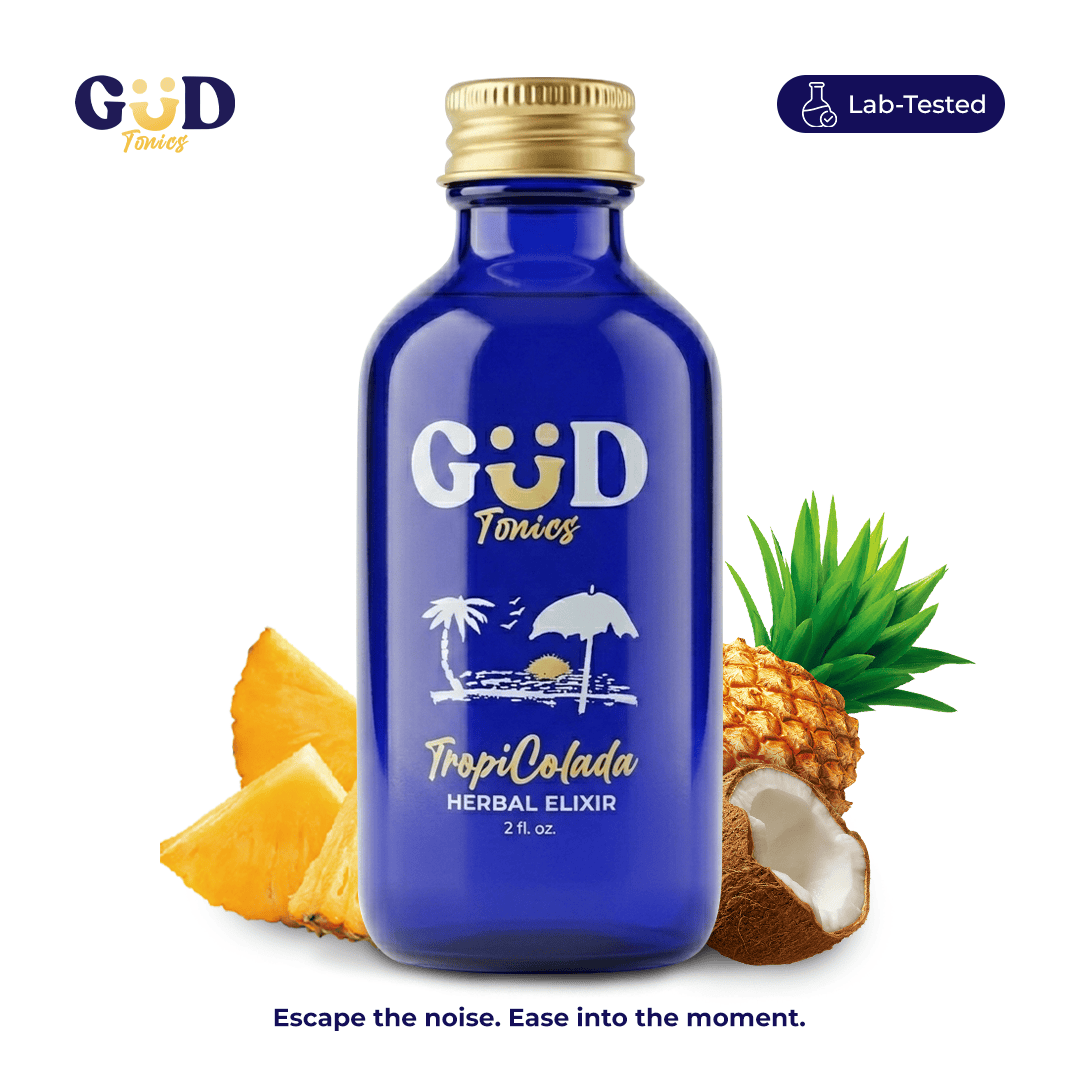
| TropiColada | Ready to drink bottle | Pineapple and coconut, colada style | Noble kava root extract | Yes, Mitragyna Speciosa | $10.99 single, $29.00 3-pack, $115.00 box of 12 |
| GÜD Tonics Bundle | One bottle of each flavor | All three above | Noble kava root extract | Yes, Mitragyna Speciosa | $27.99 |
| Raw Kava Extract Powder | Loose powder, 1oz or 3oz | Unflavored | Kava root extract | Not listed on the product page | $60.00 for 1oz, $160.00 for 3oz |
A few label facts that apply across the three ready-to-drink flavors. They are alcohol-free. They are lightly sweetened with stevia. Each bottle is labeled as two servings. They are manufactured under Rebel Brands in Austin, Texas.
What we stock, and what we don't
Five items is the entire GÜD Tonics line. We are saying that plainly because the older version of this page, and several others on this blog, pointed readers at products under names and web addresses that no longer exist. If you arrived from an old link, that is why.
We do not sell a kava tea, a kava capsule, a kava tincture, an instant kava, or a kava product without kratom other than the powder above. If you see those attributed to us somewhere, they are not ours.
The current line lives on one page: the GÜD Tonics shop. If a product is not on that page, we do not make it.
Lab testing, and what we can show you today
All three ready-to-drink flavors are currently Lot 082026, with reports dated 6 August 2026. The Raw Kava Extract Powder is Lot CKW-C-A508380, with a report dated 18 August 2025. Both sit on our lab results page.
Two things about that are worth saying out loud rather than leaving for you to notice. The powder's report is about a year older than the drinks' reports, which is a real gap. And a lot number is only worth anything if it matches the bottle in your hand, so check it rather than taking ours on faith.
We wrote a guide to doing exactly that: how to read the lab report on a drink you already own. It covers what the numbers on a certificate mean, what a stale test date looks like, and what to do if the lot on the bottle does not match the lot on the paper.
We point you at the reports rather than quoting figures out of them here. When the lot information on this page changes, the revision history below will say so.
Safety and legality
This part is not optional reading and we are not going to soften it.
Kava has a documented association with liver injury. The National Center for Complementary and Integrative Health states it directly: "Various kava products have been linked to rare cases of liver injury, some of which have been serious or even fatal." NCCIH notes that the reported cases have involved different kinds of products, including both extracted supplements and water-prepared beverages, and that the suspected contributing factors include the plant variety used, consumption alongside alcohol, product contamination, individual genetics, and how much is taken and for how long. You can read the full NCCIH page on kava.
NCCIH is also specific about two things worth repeating here. On pregnancy: "Kava may have special risks if taken during pregnancy or while breastfeeding because of the presence of harmful pyrone constituents." On combinations: "Kava should not be used together with other substances that have sedative effects, such as benzodiazepines or alcohol. If you take any type of medicine, talk with your health care provider before using kava or other herbal products; some herbs and medicines interact in harmful ways."
Read that last quote as the operative rule for our products too. Do not combine them with alcohol.
On the regulatory side, kava and kratom products are sold as dietary ingredients and the framework for that sits with the FDA. Their dietary supplements resource is the right starting point, and it is a better one than any vendor's summary, including ours.
On state law, we are deliberately not printing a list of legal and banned states on this page. Those lists change month to month, the aggregated versions of them contradict each other, and a table frozen into a blog post in June is wrong by September. Our checkout enforces the current restrictions, and every product page carries the list that applies to that item. Those are the two places to look.
Kratom carries its own separate cautions, which are set out in the section on Mitragyna Speciosa above. If you are buying one of the three ready-to-drink flavors, both sets apply to you.
Everything here is for adults 21 and over. None of it is medical advice, and none of it is legal advice.
How we revise this guide
Our content is not static and we do not pretend it is. We revise these guides as new information arrives and as we learn things we did not know when we wrote the first version. Dating a page is the point, not a formality. A guide with no date on it is asking you to trust that nothing has changed since it was written, and in this category something has usually changed.
So every revision gets a date at the top and an entry here saying what moved.
Revision history
- 18 September 2026. Substantial rewrite. Removed the seven-round comparison between kava and alcohol and every conclusion drawn from it, along with all claims about how these products make a person feel. Removed a statement about how quickly effects are noticed. Removed guidance about how much to drink. Moved the kratom disclosure to the top of the page and added the published cautions for kratom, which the previous version did not carry. Replaced the product section with the five items we actually sell, after the previous version recommended a product under a name and web address that no longer exist. Replaced a citation that was attributed to one organization but linked to another. Added the current lot numbers and report dates, including the fact that the powder's report is the older of the two. Rewrote the title and the search description. The web address is unchanged.
- 24 June 2026. Original publication.
If you find something on this page that is out of date, incomplete or simply wrong, tell us and we will fix it and date the fix. Corrections from readers are the cheapest research we get, and we would rather be corrected in an email than be wrong in public for another six months.
Frequently asked questions
Do GÜD Tonics drinks contain kratom?
Yes. All three ready-to-drink flavors, Baja Bliss, Pink Sunset and TropiColada, contain Mitragyna Speciosa alongside noble kava root extract. The bundle contains one of each, so it does too. The Raw Kava Extract Powder is sold as a kava root extract and does not list kratom on its product page. If this matters to your purchase, read the product page and the label before you order.
What is the difference between kava and kratom?
They are two different plants. NCCIH describes kava, Piper methysticum, as "native to the South Pacific and a member of the pepper family," and the root is the part used. It describes kratom, Mitragyna Speciosa, as "a tree in the coffee family, found in Thailand and neighboring countries," and the leaf is the part used. They are regulated separately and a state may treat one differently from the other.
Are GÜD Tonics drinks alcoholic?
No. All three ready-to-drink flavors are alcohol-free. That is a statement about what is in the bottle and nothing more.
Can I drink these with alcohol?
No. NCCIH advises that kava "should not be used together with other substances that have sedative effects, such as benzodiazepines or alcohol." That applies to our products.
Who should not use these products?
Anyone under 21. Anyone who is pregnant or breastfeeding. Anyone with a liver condition, and anyone taking medication, should speak with a healthcare provider before using kava. Kava has a documented association with rare but serious liver injury, which is covered in full in the safety and legality section above.
How much does a GÜD Tonics drink cost?
A single bottle of any flavor is $10.99. A 3-pack is $29.00 and a box of 12 is $115.00. The bundle of all three flavors is $27.99. The Raw Kava Extract Powder is $60.00 for 1oz and $160.00 for 3oz.
Why does this page not say whether kava is better than alcohol?
Because we cannot support that claim and would not stand behind it. The reasoning is set out in why this page used to say something else.
Where can I buy GÜD Tonics?
Every product we make is on one page. Some states and counties are restricted at checkout and each product page lists the ones that apply to it.
The summary
Kava is the root of a South Pacific plant in the pepper family. Kratom is the leaf of a tree in the coffee family. Our three ready-to-drink flavors contain both, our powder is sold as a kava extract on its own, and those five items are the entire line. Single bottles are $10.99, the bundle is $27.99, and the powder starts at $60.00.
Kava carries a real and documented liver risk, should not be combined with alcohol or with sedating medication, is not for anyone pregnant or breastfeeding, and is for adults 21 and over. Those are the facts we can stand behind.
What we will not tell you is how any of it will feel, or how it stacks up against a drink. If that is what you came for, we do not have it, and a page that offers it to you is telling you something it cannot know.